
Sudden Cardiac Arrest Treatment in Delhi
Sudden cardiac arrest is one of the most time-critical medical emergencies a person can face. When the heart abruptly stops beating, blood supply to the brain and vital organs is cut off within seconds. Without immediate intervention, CPR, defibrillation, and advanced cardiac life support, the chances of survival fall sharply with every passing minute.
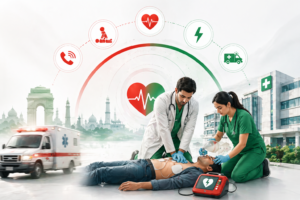
For patients and families in Delhi seeking expert emergency cardiac arrest care, Dr. Dinesh Kumar Mittal, Senior Director and Head of Cardiothoracic and Vascular Surgery at Fortis Hospital, Shalimar Bagh, provides specialist evaluation, post-resuscitation management, and long-term cardiac treatment to address the underlying cause of cardiac arrest and reduce the risk of recurrence.
Request a Consultation
What Is Sudden Cardiac Arrest?
Sudden cardiac arrest (SCA) occurs when the heart’s electrical system malfunctions, causing it to stop pumping blood altogether. Unlike a heart attack, which is caused by a blockage in the coronary arteries, sudden cardiac arrest is primarily an electrical problem. The heart goes into a chaotic, ineffective rhythm, most commonly ventricular fibrillation, and ceases to function as a pump.
The result is immediate: the person loses consciousness, stops breathing normally, and has no detectable pulse. Sudden cardiac death can follow within minutes if resuscitation is not started.
This distinction matters because the treatments differ significantly. A heart attack may allow time for assessment and intervention; sudden cardiac arrest does not.
Heart Attack vs Cardiac Arrest: What Is the Difference?
This is one of the most commonly misunderstood areas in emergency cardiac care, and the confusion can delay a life-saving response.
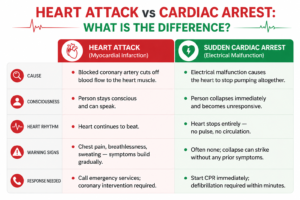
Critically, a heart attack can trigger a sudden cardiac arrest, which is why the two conditions are often confused. But they are not the same thing, and recognising the difference is the first step in responding correctly.
What Are the Signs and Symptoms of Sudden Cardiac Arrest?
Sudden cardiac arrest typically strikes without warning. However, some people experience brief warning signs in the minutes or hours before:
- Sudden collapse or loss of consciousness
- No pulse or normal breathing
- Unresponsiveness to touch or sound
- Gasping or abnormal breathing (agonal breathing)
Possible warning signs that may precede cardiac arrest:
- Rapid or irregular heartbeat (palpitations)
- Chest discomfort or pain
- Sudden dizziness or lightheadedness
- Unexplained shortness of breath
- Nausea or cold sweats
In many cases, there are no prior symptoms. This makes understanding the risk factors and addressing underlying cardiac conditions critically important.
Causes of Sudden Cardiac Arrest
Sudden cardiac arrest is most commonly caused by ventricular fibrillation, a disorganised electrical rhythm in which the lower chambers of the heart quiver rather than contract. Several underlying conditions can trigger this:
Primary cardiac causes:
- Coronary artery disease (CAD), the most common underlying cause in adults
- Previous heart attack causing scarred, electrically unstable heart muscle
- Atrial fibrillation and other arrhythmias
- Heart valve disease, including aortic stenosis
- Cardiomyopathy (enlarged or weakened heart muscle)
- Congenital heart conditions, including ventricular septal defect (VSD) and congenital heart disease
Contributing risk factors:
- Uncontrolled hypertension
- Diabetes
- Smoking
- Family history of sudden cardiac death
- Prior cardiac arrest or known arrhythmia
- Severe electrolyte imbalances
Identifying and managing these conditions before a cardiac arrest occurs is the most effective form of sudden cardiac death prevention.
Sudden Cardiac Arrest Treatment Procedure in Delhi
Cardiac arrest treatment in Delhi is a sequence of urgent and coordinated actions. In Emergency cardiac care in Delhi, every stage matters, and outcomes are directly tied to how quickly each step is delivered.
Immediate Response: CPR and Resuscitation
When someone collapses and is unresponsive, the first priority is calling emergency services and beginning hands-only CPR immediately. Chest compressions maintain a minimal level of blood flow to the brain and heart until advanced help arrives.
Early CPR, started within the first 1-2 minutes, can double or triple the chance of survival.
Defibrillation
For ventricular fibrillation, the most common cause of cardiac arrest, a defibrillator is required to deliver an electric shock that resets the heart’s rhythm. Automated External Defibrillators (AEDs) are increasingly available in public spaces and can be used by bystanders before emergency teams arrive. Each minute without defibrillation reduces survival chances by approximately 7-10%.
Advanced Cardiac Life Support (ACLS Treatment)
Once emergency medical teams arrive, ACLS treatment begins. This involves:
- Advanced airway management (intubation or supraglottic device)
- Continuous cardiac monitoring
- Intravenous medications, including adrenaline and antiarrhythmics such as amiodarone
- Systematic identification and reversal of reversible causes, known as the 4Hs and 4Ts (hypoxia, hypovolaemia, hypo/hyperkalaemia, hypothermia; tension pneumothorax, tamponade, toxins, thrombosis)
Post-Resuscitation Care and Cardiac Evaluation
Surviving the initial event is only the first step. Patients who are successfully resuscitated require close monitoring in a cardiac intensive care unit (ICU) and a thorough evaluation to identify what caused the arrest.
Post-arrest management typically includes:
- Targeted temperature management (cooling therapy) where indicated
- Coronary angiography to identify and treat any underlying coronary artery disease or blockage, which may lead to CABG surgery or coronary angioplasty
- Echocardiography to assess heart function
- An electrophysiology study to evaluate the heart’s electrical system
- Assessment for implantable cardioverter-defibrillator (ICD) implantation
Long-Term Treatment: Addressing the Root Cause
Cardiac arrest treatment does not end at resuscitation. The underlying cause must be identified and addressed to prevent a recurrence. Depending on the findings, long-term management may include:
- Surgical intervention, such as open heart surgery or valve replacement, for structural heart disease
- ICD implantation for patients at continued risk of life-threatening arrhythmia
- ECMO (Extracorporeal Membrane Oxygenation) in cases of refractory cardiac arrest or cardiogenic shock
- Antiarrhythmic medications
- Cardiac rehabilitation and lifestyle management
What Is the Survival Rate for Sudden Cardiac Arrest?
Cardiac arrest survival rates are heavily dependent on how quickly bystander CPR and defibrillation are delivered. In out-of-hospital cardiac arrests, survival rates in India remain low, largely due to delays in resuscitation and access to emergency care. When CPR is started within 1-2 minutes, and defibrillation is delivered within 3-5 minutes, survival rates can reach 40-50% or more. Without these interventions, survival falls dramatically.
In-hospital cardiac arrests, where resuscitation can begin almost immediately, have significantly better outcomes.
This reinforces two things: the importance of bystander CPR training and the value of identifying and treating underlying cardiac conditions before an event occurs.
Why Patients Choose Dr. Dinesh Kumar Mittal for Cardiac Arrest Treatment in Delhi
Sudden cardiac arrest leaves no room for delay, and recovery demands a surgeon and cardiac team with the depth of experience to manage both the emergency and the underlying cause.
Dr. Dinesh Kumar Mittal is one of the best cardiothoracic and vascular surgeons, with over 25 years of specialist practice and more than 10,000 cardiac surgeries performed. Patients across Delhi NCR choose him for cardiac arrest treatment and post-arrest cardiac care because of:
- 25+ years of cardiothoracic and vascular surgical expertise, covering the full spectrum of emergency and elective cardiac conditions
- Advanced surgical capability across CABG, open heart surgery, valve replacement, aortic intervention, and ECMO, enabling comprehensive management of the structural causes behind cardiac arrest
- Super-speciality training (MCh, AIIMS New Delhi), India’s highest qualification in cardiothoracic surgery
- Fellowship in Endovascular Stenting, Milan, Italy, bringing internationally trained expertise to complex interventional cases
- Pioneer of North India’s Aortic Intervention Programme and founder of a dedicated Neonatal Cardiac Surgery Programme
- State-of-the-art infrastructure at Fortis Hospital, Shalimar Bagh; NABH-accredited care with dedicated cardiac ICUs and round-the-clock emergency cardiac support
His approach integrates emergency resuscitation support with a thorough diagnostic workup and targeted surgical or interventional treatment to address what caused the arrest, not just what happened in the moment.
Book a Consultation for Cardiac Arrest Treatment in Delhi
If you or a family member has survived a cardiac arrest, or if you have been identified as being at high risk due to coronary artery disease, arrhythmia, or a family history of sudden cardiac death, a specialist consultation is the most important step you can take.
Early intervention, whether through surgical treatment, ICD implantation, or structured medical management, significantly reduces the risk of sudden cardiac death.
During your consultation with Dr. Dinesh Kumar Mittal, you will receive:
- Detailed review of your cardiac history, symptoms, and risk factors
- Evaluation of existing reports, including ECG, echocardiogram, and angiography, where available
- Assessment of arrhythmia risk and structural heart disease
- A clear explanation of treatment options and what each involves
- Transparent guidance on next steps, whether that is intervention, monitoring, or medication management
Do not wait for a second event to occur. If cardiac arrest risk has been identified, early expert evaluation can be life-saving.
Frequently Asked Questions
What is ACLS treatment? expand_more
Advanced Cardiac Life Support (ACLS) is a set of clinical protocols used by trained medical teams to manage cardiac arrest. It includes CPR, defibrillation, advanced airway management, intravenous medications, and the systematic identification of reversible causes.
What is the cost of sudden cardiac arrest treatment in Delhi? expand_more
The cost of sudden cardiac arrest treatment in Delhi typically ranges from ₹2 lakh to ₹5 lakh, depending on ICU stay, ventilator support, and procedures like angioplasty. Emergency care alone may range from ₹10,000 to ₹30,000, with ICU charges.
Who is the best doctor for sudden cardiac arrest treatment in Delhi? expand_more
Dr Dinesh Mittal is one of the leading cardiac surgeons in Delhi, known for advanced emergency cardiac care, rapid intervention, and high success rates in treating patients with sudden cardiac arrest.
Can a person survive sudden cardiac arrest? expand_more
Yes, survival is possible, and early CPR and defibrillation are the most important factors. Patients who are successfully resuscitated require thorough cardiac evaluation and long-term treatment to address the underlying cause and reduce the risk of a future event.
How do I book a consultation with Dr. Dinesh Kumar Mittal? expand_more
You can book an appointment with Dr. Dinesh Kumar Mittal by contacting Fortis Hospital, Shalimar Bagh, directly or using their online appointment booking facility.

Dr. Dinesh Kumar Mittal's Content Team
Dr. Dinesh Kumar Mittal's medical content team specialises in creating accurate, clear, and patient-focused healthcare content. With strong clinical understanding and expertise in technical writing and SEO, the team translates complex medical information into reliable, accessible resources that support informed decisions and uphold Dr. Mittal's commitment to quality care.
This content is reviewed by Dr. Dinesh Kumar Mittal

Related Blogs
Top 5 Early Signs of Cardiovascular Diseases Everyone Should Know
Cardiovascular diseases (CVDs) remain one of the leading causes of death worldwide, affecting millions each…
Read Article →
How Quitting Smoking Benefits Your Lung and Heart Health?
Did you know that smoking causes nearly 85% of lung cancer deaths, as reported…
Read Article →
Are Heart Attacks More Common in Winter? The Truth Behind the Myth
As winter arrives, many people focus on enjoying the season’s festivities, cosying up indoors,…
Read Article →
Can Stem Cell Therapy Regenerate Heart Tissue?
Imagine a future where the heart can heal itself. With cutting-edge innovations in medical…
Read Article →
Understanding Non-Cardiac Chest Pain: Exploring Common Thoracic Causes
Do you feel a dull ache or a sharp stab in and around your…
Read Article →
When Shortness of Breath Signals a Serious Issue?
Have you ever felt suffocated when breathing and gasped for air? Well, you are…
Read Article → WhatsApp