
Aortic Aneurysm Treatment in Delhi
An aortic aneurysm is a condition in which a section of the aorta, the body’s largest and most vital artery, develops an abnormal bulge or ballooning due to weakness in the artery wall. Because the aorta carries oxygen-rich blood from the heart to the rest of the body, even a partial weakening of its wall can have life-threatening consequences if it is not identified and managed in time.
In India, aortic aneurysms remain significantly underdiagnosed. Many patients live with the condition for years without any symptoms, only discovering it incidentally on a scan done for an unrelated reason. Yet a ruptured or bleeding aneurysm is a surgical emergency with a mortality rate that exceeds 80% without immediate intervention, according to data published in the Journal of Vascular Surgery.
Dr. Dinesh Kumar Mittal, Senior Director and Head of Cardiothoracic and Vascular Surgery at Fortis Hospital, Shalimar Bagh, Delhi, provides comprehensive aortic aneurysm treatment, from careful watchful waiting and medical management through to open surgical repair and endovascular aortic stent procedures, for patients across Delhi NCR and beyond.
Request a Consultation
What Is an Aortic Aneurysm?
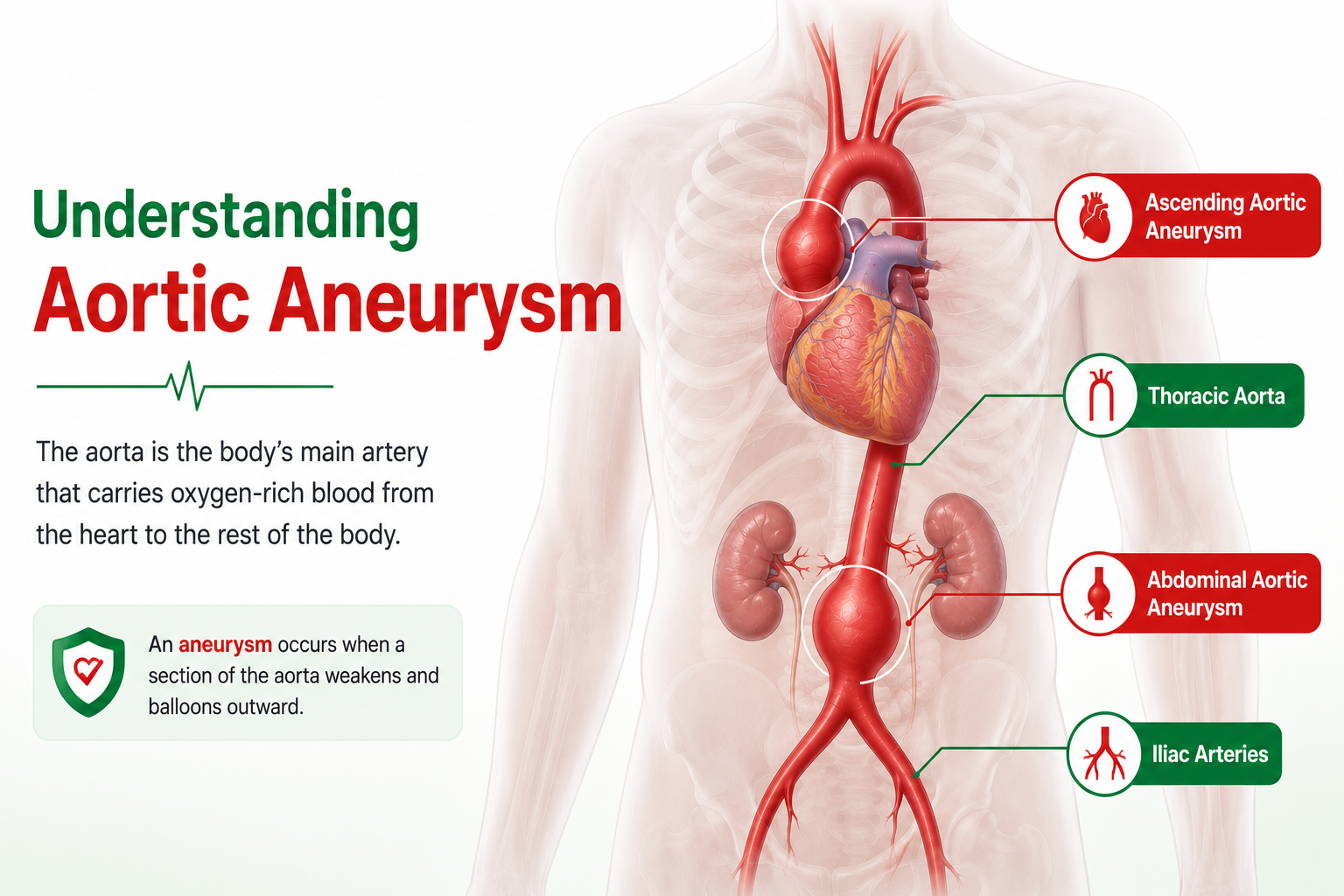
An aortic aneurysm occurs when a section of the aorta wall weakens and expands outward, forming a bulge that grows over time. The aorta is not a single short vessel; it is a long, curved artery that begins at the heart and travels downward through the chest and abdomen before branching into the arteries supplying the legs.
Understanding aorta location is important for patients: the aorta begins at the aortic valve of the heart, curves through the chest (thoracic aorta), and continues through the abdomen (abdominal aorta). An aneurysm can form at any point along this route.
How an aortic aneurysm develops:
- The inner wall of the aorta is damaged, most commonly by atherosclerosis (plaque build-up), hypertension, or genetic conditions
- The muscular and elastic layers of the aortic wall weaken progressively
- Blood pressure inside the vessel causes the weakened segment to expand outward
- Over time, the aneurysm enlarges; beyond a critical diameter, the risk of rupture increases significantly
- A rupturing or bleeding aneurysm releases blood at extremely high pressure into the surrounding tissues or body cavity, a life-threatening emergency
A key distinction: an aortic aneurysm is not the same as an aortic dissection, though both conditions involve the aortic wall and can present similarly. Aortic dissection involves a tear within the wall layers, while an aneurysm is an outward bulge of the entire vessel.
Types of Aortic Aneurysm
Aortic aneurysm types are classified by their location along the aorta. Each type carries different risks, symptoms, and treatment approaches.
1. Thoracic Aortic Aneurysm (TAA)
Located in the chest portion of the aorta. This category includes:
- Ascending aortic aneurysm: Affects the segment of the aorta as it rises from the heart; often associated with bicuspid aortic valve or connective tissue disorders
- Ascending root aneurysm (Aortic Root Aneurysm): Involves the very base of the aorta, the aortic root, where the aorta connects to the heart and the coronary arteries arise. An ascending root aneurysm is particularly complex because repair must account for both the aortic valve and the coronary artery origins. The Bentall procedure is the standard surgical approach for this type.
- Aortic arch aneurysm: Affects the curved top section of the aorta
- Descending thoracic aneurysm: Located in the descending portion within the chest, behind the heart
2. Abdominal Aortic Aneurysm (AAA)
An abdominal aortic aneurysm is located in the abdominal section of the aorta, below the diaphragm. This is the most common type, accounting for approximately 75% of all aortic aneurysms. According to the British Journal of Surgery, AAA affects around 4-8% of men over 65 years of age.
3. Thoracoabdominal Aortic Aneurysm (TAAA)
Spans both the chest and abdominal portions of the aorta, the most extensive and technically demanding type to repair.
What Are the Symptoms of an Aortic Aneurysm?
Aortic aneurysm symptoms are frequently absent until the aneurysm becomes large or begins to rupture. This silent progression is what makes the condition so dangerous.
Symptoms that may appear as the aneurysm grows:
- Deep, persistent pain in the chest, back, or abdomen, depending on the aneurysm’s location
- A pulsating sensation in the abdomen (more common in AAA)
- Unexplained shortness of breath or difficulty swallowing (in thoracic aneurysms)
- Hoarseness or a persistent cough (if the aneurysm presses on nearby structures)
Warning signs that may indicate rupture or a bleeding aneurysm:
- Sudden, severe tearing or ripping pain in the chest, back, or abdomen
- Rapid drop in blood pressure or loss of consciousness
- Extreme weakness or pallor
- Signs of shock: cold sweats, rapid pulse, confusion
A bleeding aneurysm is a medical emergency. These symptoms require immediate hospital attendance, time is critical.
Even without symptoms, the following warrant an assessment:
- Incidental finding of aortic dilatation on a scan
- Strong family history of aortic aneurysm
- Diagnosis of a connective tissue disorder (Marfan syndrome, Ehlers-Danlos syndrome)
- Known coronary artery disease alongside high blood pressure and smoking history
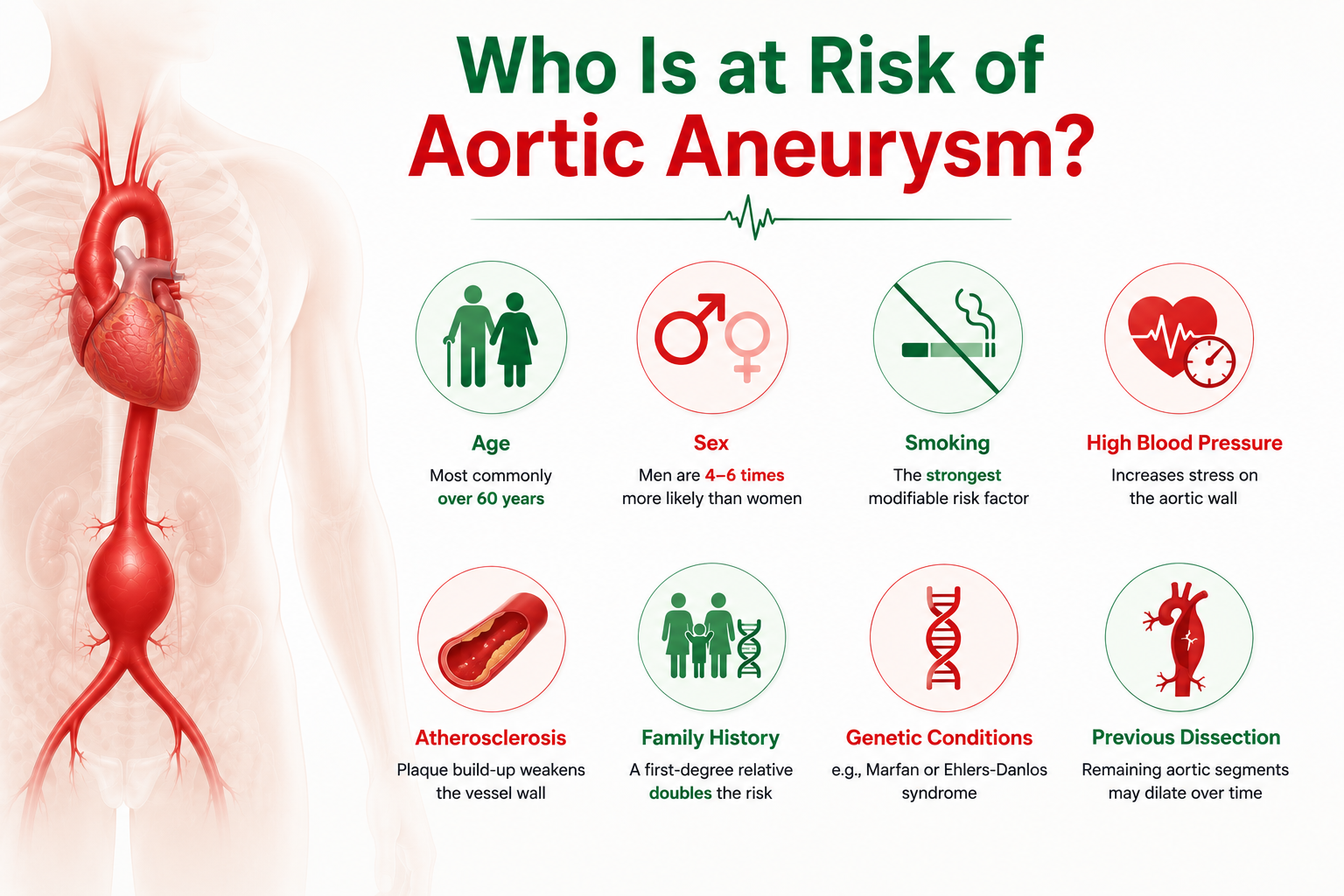
Who Is at Risk of Aortic Aneurysm?
Aortic aneurysms develop over many years. Certain factors significantly increase the risk:
Patients with deep vein thrombosis (DVT) or peripheral vascular disease are also at heightened cardiovascular risk and should discuss aortic screening with their specialist.
How Is an Aortic Aneurysm Diagnosed?
Early, accurate diagnosis is the cornerstone of effective aortic aneurysm treatment. Most aneurysms are detected incidentally during imaging performed for another reason. When an aneurysm is suspected, the following investigations are used:
| Diagnostic Test | What It Shows | When It Is Used |
| Ultrasound (Aortic Duplex) | Detects and measures abdominal aneurysm size | First-line, non-invasive, radiation-free |
| CT Angiography (CTA) | Detailed anatomy, aneurysm dimensions, and relation to branches | Standard before any aortic intervention |
| MR Angiography (MRA) | Thoracic and abdominal aorta imaging | Preferred when avoiding radiation in younger patients |
| Echocardiography (TTE/TOE) | Evaluates ascending aorta, aortic root, and valve function | Key for ascending root aneurysm assessment |
| Digital Subtraction Angiography (DSA) | Real-time catheter-based imaging | Used in complex or prior-to-intervention planning |
| Chest X-Ray | May show a widened mediastinum, suggesting a thoracic aneurysm | An incidental finding requires confirmatory imaging |
The size of the aneurysm, particularly its maximum diameter, is the most important factor in deciding whether and when to intervene. Serial imaging (monitoring the aneurysm over time) is recommended for aneurysms that do not yet meet the threshold for intervention.
Aortic Aneurysm Treatment Options in Delhi
Aortic aneurysm treatment is guided by the size and location of the aneurysm, the rate at which it is growing, the presence of symptoms, and the patient’s overall health. Not every aneurysm requires immediate surgery. Treatment ranges from active monitoring and medication to endovascular aortic stent placement or open surgical repair.
1. Watchful Waiting and Medical Management
For small aneurysms that are not yet at the threshold for intervention, careful surveillance combined with medical therapy is the appropriate approach.
- Regular CT or ultrasound imaging to monitor aneurysm size (typically every 6-12 months)
- Strict blood pressure control, maintaining systolic pressure below 130 mmHg significantly reduces the rate of aneurysm growth
- Statin therapy to stabilise the aortic wall and reduce cardiovascular risk
- Smoking cessation, the most critical lifestyle modification
- Beta-blockers or ACE inhibitors, particularly in patients with connective tissue disorders
Medical management does not shrink an aneurysm. Its purpose is to slow growth and reduce rupture risk until surgery is indicated, or to protect high-risk patients for whom intervention carries unacceptable risk.
2. Endovascular Aneurysm Repair (EVAR / TEVAR): Aortic Stent Procedure
Endovascular repair is a minimally invasive aneurysm treatment in which a stent-graft, a fabric tube supported by a metal mesh framework (aortic stent), is delivered through catheters inserted in the groin and positioned inside the aneurysm under X-ray guidance.
Once deployed, the aortic stent excludes the aneurysm from the circulation. Blood flows through the stent-graft rather than the weakened aneurysm wall, removing the pressure that would otherwise cause further expansion or rupture.
- EVAR (Endovascular Aneurysm Repair): Used for abdominal aortic aneurysms
- TEVAR (Thoracic Endovascular Aortic Repair): Used for descending thoracic aneurysms
Advantages of endovascular aortic stent repair:
- No large incision; access through the groin
- Shorter hospital stay (typically 2-3 days)
- Faster recovery compared to open surgery
- Suitable for patients at higher operative risk
Endovascular repair requires careful anatomical suitability. Not all aneurysms, particularly ascending root aneurysm and aortic arch aneurysms, can be treated with an aortic stent alone. Many require open surgery or hybrid approaches.
3. Open Surgical Aortic Aneurysm Repair
Open surgical repair remains the gold standard for many thoracic aneurysms, ascending root aneurysm, and complex abdominal cases where endovascular access is not feasible.
The procedure involves opening the chest or abdomen, clamping the aorta above and below the aneurysm, and replacing the diseased segment with a synthetic graft, a durable tube that takes over the aorta’s function permanently.
Specific procedures include:
- Ascending aortic replacement: For aneurysms of the ascending aorta
- Bentall procedure: For ascending root aneurysm involving the aortic valve and coronary artery origins, replaces the aortic root, valve, and re-implants the coronary arteries
- Aortic arch replacement: Complex surgery requiring circulatory arrest to repair the curved top section of the aorta
- Thoracoabdominal aortic repair: Extensive surgery for TAAA involving both chest and abdominal segments
- Aneurysm repair surgery: For abdominal aortic aneurysms not suitable for EVAR
Open repair carries a longer recovery period (typically 4-8 weeks) but offers excellent long-term durability, particularly in younger patients or those with complex anatomy.
4. Emergency Treatment for a Bleeding Aneurysm (Rupture)
A bleeding aneurysm requires emergency surgery, either open repair or emergency EVAR depending on the patient’s haemodynamic stability and the anatomy. Outcomes are significantly better at centres with experienced aortic surgical teams and 24-hour emergency vascular capability.
Aortic Aneurysm Complications: What Happens If It Is Left Untreated?
Aortic aneurysm complications are severe and often fatal when the condition is not managed appropriately. Understanding what is at stake often helps patients and families make timely decisions about treatment.
The most serious aortic aneurysm complications include:
- Rupture and internal bleeding: The most feared outcome. A ruptured abdominal aortic aneurysm carries an overall mortality of approximately 65-85%, including patients who do not reach hospital in time.
- Aortic dissection: The weakened wall may develop a tear, allowing blood to track between the wall layers. This is a separate but related emergency (see our page on aortic dissection treatment in Delhi).
- Thromboembolism: Blood clots can form inside the aneurysm sac and travel downstream, blocking arteries supplying the kidneys, intestines, or legs.
- Compression of nearby structures: A large aneurysm may press on the spine, oesophagus, or ureters, causing pain, difficulty swallowing, or kidney obstruction.
- Heart failure: Ascending root aneurysm can distort the aortic valve, causing significant aortic regurgitation, which places progressive strain on the heart. This may require combined aortic valve repair or replacement.
Early detection and elective intervention, when the aneurysm reaches the treatment threshold, eliminates the risk of these complications and is associated with far better outcomes than emergency repair.
Aortic Aneurysm Treatment Cost in Delhi
The cost of aortic aneurysm treatment in Delhi varies based on the type of intervention required, the extent of the aneurysm, the anaesthesia and operation theatre charges, and the duration of hospital stay.
| Treatment Type | Estimated Cost (INR) |
| Medical management and monitoring | ₹5,000 – ₹20,000 per visit (including imaging) |
| CT Angiography (aortic) | ₹8,000 – ₹18,000 |
| Endovascular Repair (EVAR/TEVAR) – Aortic Stent | ₹3,50,000 – ₹6,50,000 |
| Open Surgical Aortic Aneurysm Repair | ₹3,00,000 – ₹6,00,000 |
| Bentall Procedure (ascending root aneurysm) | ₹4,00,000 – ₹7,50,000 |
These figures are indicative. The final cost is confirmed during consultation following a review of CT angiography findings, aneurysm extent, and the treatment plan. Most health insurance policies in India cover aortic aneurysm repair, both open and endovascular, under inpatient hospitalisation benefits.
Cost for International Patients
Aortic aneurysm treatment in Delhi delivers world-class surgical expertise at a fraction of the cost in the UK, USA, or the GCC, without any compromise in hospital accreditation or surgical standards.
| Currency | Endovascular Repair (EVAR/TEVAR) | Open Surgical Repair / Bentall |
| USD | USD 4,200 – 8,000 | USD 3,600 – 9,200 |
| GBP | GBP 3,300 – 6,300 | GBP 2,800 – 7,200 |
| AED | AED 15,400 – 29,000 | AED 13,200 – 33,800 |
Currency conversions are indicative and subject to change. International patients are welcome to share their CT angiography or echocardiography reports with Dr. Dinesh Kumar Mittal for a remote pre-travel assessment and a confirmed cost estimate before making travel arrangements.
Why Patients Trust Dr. Dinesh Kumar Mittal for Aortic Aneurysm Treatment in Delhi?
Aortic surgery demands an exceptional level of technical precision, judgement, and institutional support. The aorta is the body’s main arterial highway; errors in surgical planning or execution carry irreversible consequences.
Dr. Dinesh Kumar Mittal has spent over 25 years building specific expertise in aortic and vascular surgery, and has contributed to one of the leading Aortic Intervention Programmes in North India at Fortis Hospital, Shalimar Bagh.
Patients across Delhi NCR choose Dr. Mittal because of:
- 25+ years of cardiothoracic and vascular surgical experience, including complex aortic cases
- Leadership of the Aortic Intervention Programme at Fortis Hospital, Shalimar Bagh, one of North India’s most established aortic surgery centres
- Expert in ascending root aneurysm repair, Bentall procedure, EVAR, and TEVAR
- Fellowship in Endovascular Stenting (Milan, Italy), directly applicable to aortic stent procedures
- MCh in CTVS from AIIMS, New Delhi, India’s highest post-graduate surgical qualification
- Fully equipped catheterisation laboratory and dedicated cardiac ICU at Fortis Hospital for complete aortic care under one roof
- Personalised treatment planning based on CT angiography, patient anatomy, and individual risk profile
His philosophy is simple: an aneurysm identified before rupture is a problem that can be solved. A bleeding aneurysm is an emergency that may not always allow for one.
Book a Consultation for Aortic Aneurysm Treatment in Delhi
An aortic aneurysm that is found early and managed correctly carries an excellent prognosis. The challenge is that many patients do not know they have one until it is already large, or until it ruptures. Regular surveillance, combined with timely intervention when the aneurysm reaches the appropriate size, is the most reliable way to prevent the catastrophic aortic aneurysm complications that make this condition so feared.
Early consultation with Dr. Dinesh Kumar Mittal ensures:
- Thorough clinical review of symptoms, risk factors, and medical history
- Interpretation of existing imaging reports (CT angiography, echocardiography, or ultrasound)
- Accurate assessment of aneurysm size, location, and rate of growth
- Clear explanation of all aneurysm treatment options, watchful waiting, aortic stent (endovascular), or open surgery
- A personalised treatment plan tailored to your anatomy, age, and overall health
- Transparent discussion of expected recovery, follow-up requirements, and cost
Whether you have been diagnosed recently or have been monitoring an aneurysm for some time and are unsure of next steps, a specialist review provides the clarity needed to make the right decision, before an emergency takes that decision out of your hands. Book a consultation now.
Frequently Asked Questions
At what size does an aortic aneurysm require surgery? expand_more
For abdominal aortic aneurysms, surgical intervention is generally recommended when the diameter reaches 5.5 cm or greater in men (5.0 cm in women). Ascending root aneurysm in patients with Marfan syndrome may be repaired at smaller diameters. The decision is always individualised.
Is an aortic stent (EVAR) as durable as open surgery? expand_more
Endovascular aortic stent repair offers excellent early outcomes and shorter recovery, but requires lifelong imaging follow-up to check for endoleak (blood continuing to enter the aneurysm sac around the stent). Open surgical repair is generally more durable long-term and does not require the same intensity of surveillance.
Can an aortic aneurysm be treated without surgery? expand_more
Small aneurysms below the treatment threshold are managed with surveillance imaging and medical optimisation (blood pressure control, statins, smoking cessation). A bleeding aneurysm always requires emergency surgery.
Is aortic aneurysm treatment covered by health insurance in India? expand_more
Most health insurance policies in India cover both open surgical and endovascular aneurysm repair under inpatient hospitalisation benefits. Patients are advised to confirm the specifics of their coverage before the procedure.
How do I book a consultation with Dr. Dinesh Kumar Mittal? expand_more
You can book an appointment with Dr. Dinesh Kumar Mittal by contacting Fortis Hospital, Shalimar Bagh directly, or through the online appointment booking facility on the website.

Dr. Dinesh Kumar Mittal's Content Team
Dr. Dinesh Kumar Mittal's medical content team specialises in creating accurate, clear, and patient-focused healthcare content. With strong clinical understanding and expertise in technical writing and SEO, the team translates complex medical information into reliable, accessible resources that support informed decisions and uphold Dr. Mittal's commitment to quality care.
This content is reviewed by Dr. Dinesh Kumar Mittal
Related Blogs
Heart Surgery in India for International Patients: A Complete Guide
Every year, patients from the UK, the USA, the Gulf, and Africa fly into Delhi…
Read Article → WhatsApp