
Atrial Septal Defect Treatment in Delhi
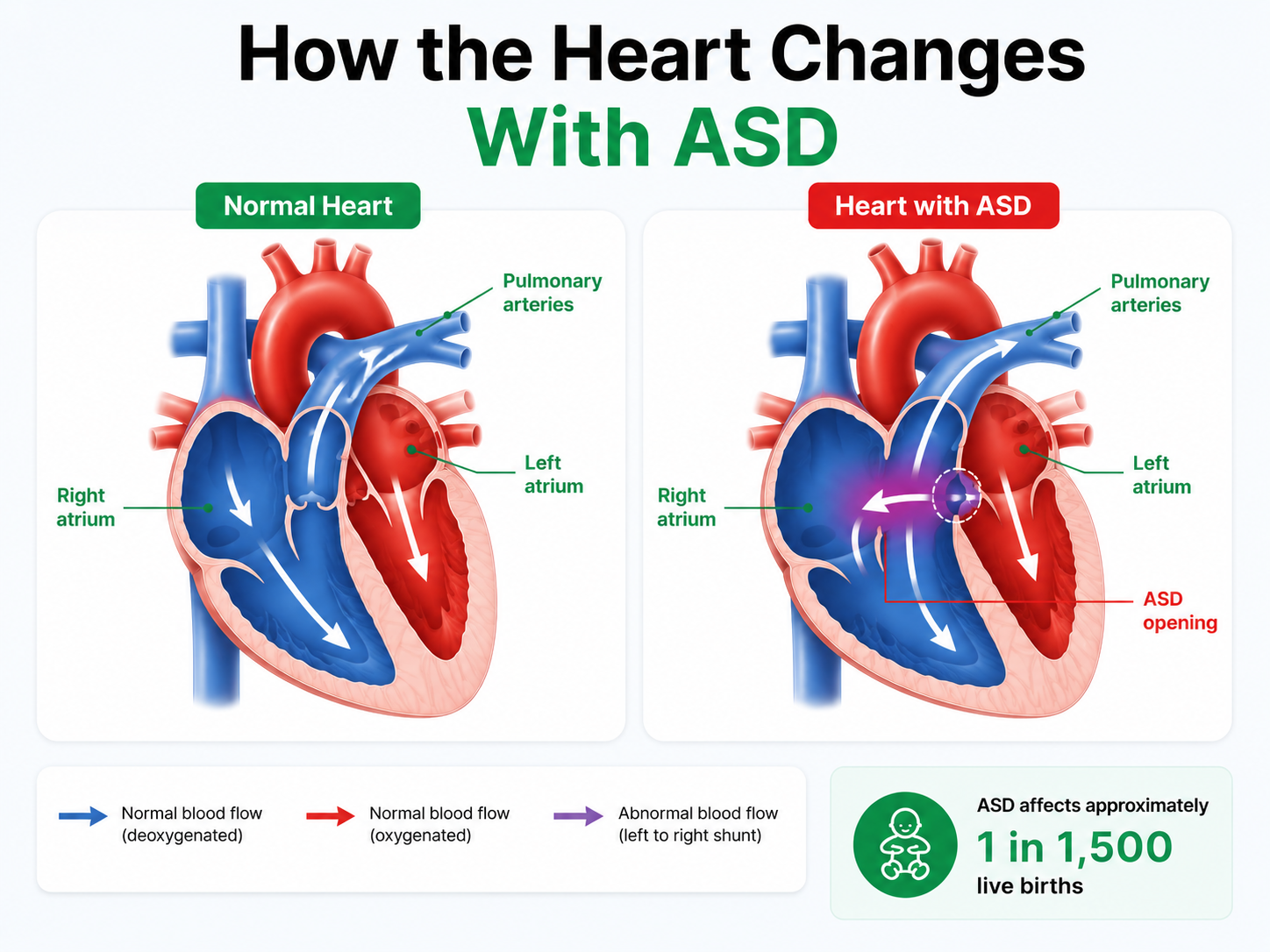
An atrial septal defect (ASD) is one of the most common congenital heart conditions, yet many people live with it for years without knowing. It is a hole in the wall (septum) that separates the two upper chambers of the heart.
The good news is that ASD is highly treatable. With modern techniques, both minimally invasive device closure and open-heart repair, most patients achieve complete correction and go on to live full, healthy lives.
Dr. Dinesh Kumar Mittal, Director and Head of Cardio Thoracic Vascular Surgery at Fortis Hospital, Shalimar Bagh, Delhi, brings over 25 years of specialist experience and more than 10,000 cardiac surgeries to the care of patients with ASD and other congenital heart conditions.
Request a Consultation
What Is Atrial Septal Defect (ASD)?
An atrial septal defect is a congenital (present from birth) opening in the atrial septum, the thin wall dividing the left and right atria (upper chambers) of the heart.
In a normal heart, the left and right sides are completely separated. The left atrium receives oxygen-rich blood from the lungs and sends it to the body. The right atrium receives oxygen-depleted blood from the body and sends it back to the lungs. When there is a hole between the two chambers, oxygenated blood leaks from the left side into the right side, forcing the lungs and the right side of the heart to handle more blood than they should.
What this means for the heart over time:
- The right side of the heart gradually enlarges
- The lungs receive too much blood, raising pulmonary artery pressure
- The heart works harder to compensate, increasing the risk of failure and rhythm problems
Small ASDs sometimes close on their own in early childhood. Moderate to large defects, however, rarely close without treatment and require specialist evaluation to determine the right timing and approach.
What Are the Types of Atrial Septal Defects?
There are four types of ASD: secundum (most common, often treated with device closure), primum (near the valves, requires surgery), sinus venosus (near the large veins, requires surgery), and coronary sinus (rare, requires surgery). The type determines the treatment approach.
1. Secundum ASD
The most common type accounts for roughly 70-75% of all ASD cases. It occurs in the central portion of the atrial septum, in an area called the fossa ovalis. Most secundum ASDs are suitable for transcatheter (device) closure without open-heart surgery, provided the defect is not excessively large and has adequate tissue margins.
2. Primum ASD
Located in the lower part of the atrial septum, close to the heart valves. This type is often associated with abnormalities of the mitral or tricuspid valve. Because of its location and associated valve involvement, primum ASD almost always requires open-heart surgical repair.
3. Sinus Venosus ASD
A less common type, located near where the large veins (superior or inferior vena cava) connect to the right atrium. Sinus venosus defects are frequently associated with partial anomalous pulmonary venous connection (PAPVC), where some pulmonary veins drain into the wrong chamber. Surgical correction is the standard approach.
4. Coronary Sinus ASD (Unroofed Coronary Sinus)
A rare variant where there is a deficiency in the wall between the coronary sinus and the left atrium. This type also requires surgical repair.
What Are the Symptoms of Atrial Septal Defect?
Atrial Septal Defect symptoms depend heavily on the size of the defect and the patient’s age. ASD symptoms include breathlessness, fatigue, heart palpitations, and frequent chest infections. Small defects may cause no symptoms for years. In adults, previously undiagnosed ASD can present with exercise intolerance, arrhythmias, or even stroke. Any unexplained heart murmur or cardiac symptom should be investigated promptly.
Symptoms in Children
- Frequent chest infections or respiratory illnesses
- Poor weight gain or growth in infancy
- Easy fatigue during play or physical activity
- A heart murmur detected by a doctor during examination
Symptoms in Adults
Many adults with undiagnosed ASD present with symptoms they had attributed to general unfitness or ageing:
- Breathlessness during physical activity or even at rest
- Persistent fatigue and reduced exercise tolerance
- Heart palpitations (irregular or rapid heartbeat)
- Swelling in the legs, ankles, or abdomen
- Recurrent chest infections
- Stroke or TIA (in rare cases, caused by a blood clot crossing through the defect, a condition called paradoxical embolism)
When symptoms are ignored over many years, complications can develop that are harder to reverse, including fixed pulmonary hypertension (Eisenmenger syndrome), which may make closure no longer advisable. Early evaluation is therefore critical.
Atrial Septal Defect Diagnosis
ASD is diagnosed with an echocardiogram, which visualises the hole and measures its size. A transoesophageal echo gives a more detailed view and is used before device closure. Additional tests such as ECG, chest X-ray, and cardiac MRI may be used to assess the extent of the condition.
Diagnostic tools used include:
- Echocardiogram (Echo): The primary investigation for ASD. A transthoracic echo (external, on the chest wall) can visualise the defect in most patients. A transoesophageal echocardiogram (TOE/TEE), where a probe is passed down the oesophagus, provides a much clearer view of the septum and is routinely used before device closure to measure the defect accurately.
- Chest X-Ray: May show an enlarged right side of the heart or increased pulmonary vascular markings if there is significant shunting.
- ECG (Electrocardiogram): Can identify characteristic patterns associated with ASD, such as right bundle branch block or right axis deviation.
- Cardiac MRI or CT Angiography: Used in select cases to evaluate associated anomalies such as abnormal pulmonary venous connections or complex anatomy.
- Cardiac Catheterisation: Occasionally used to measure pulmonary artery pressures directly, particularly in older patients or those where pulmonary hypertension is suspected.
ASD Treatment Options in Delhi
ASD is treated with either transcatheter device closure (for suitable secundum ASDs) or open-heart surgery (for primum, sinus venosus, and complex defects). Device closure is minimally invasive with a 1-2 day hospital stay; open surgery requires 5-7 days. The choice depends on the type, size, and location of the defect.
These are the two primary methods for closing an ASD, and the choice between them depends on the type, size, and location of the defect.
Device Closure vs. Open-Heart Surgery for ASD: Key Differences
| Feature | Device Closure (Transcatheter) | Open-Heart Surgery |
|---|---|---|
| Type | Minimally invasive | Open surgery |
| Suitable For | Secundum ASD (adequate rim) | Primum, sinus venosus, complex ASDs |
| Incision | None (groin puncture only) | Chest incision |
| Hospital Stay | 1-2 days | 5-7 days |
| Recovery | 1-2 weeks | 4-6 weeks |
| Anaesthesia | General or sedation | General |
| Valve Repair | Not possible | Possible |
| Scar | None visible | Chest scar |
Each patient is assessed individually. Dr. Mittal evaluates the echocardiographic anatomy carefully before recommending either approach, ensuring that patients receive the most appropriate and durable correction for their specific defect.
What Happens If ASD Is Left Untreated?
Untreated ASD can lead to pulmonary hypertension, right heart failure, atrial fibrillation, and stroke. In advanced cases, the condition may become inoperable (Eisenmenger syndrome). Timely closure, ideally in childhood or early adulthood, prevents these complications and restores normal cardiac function.
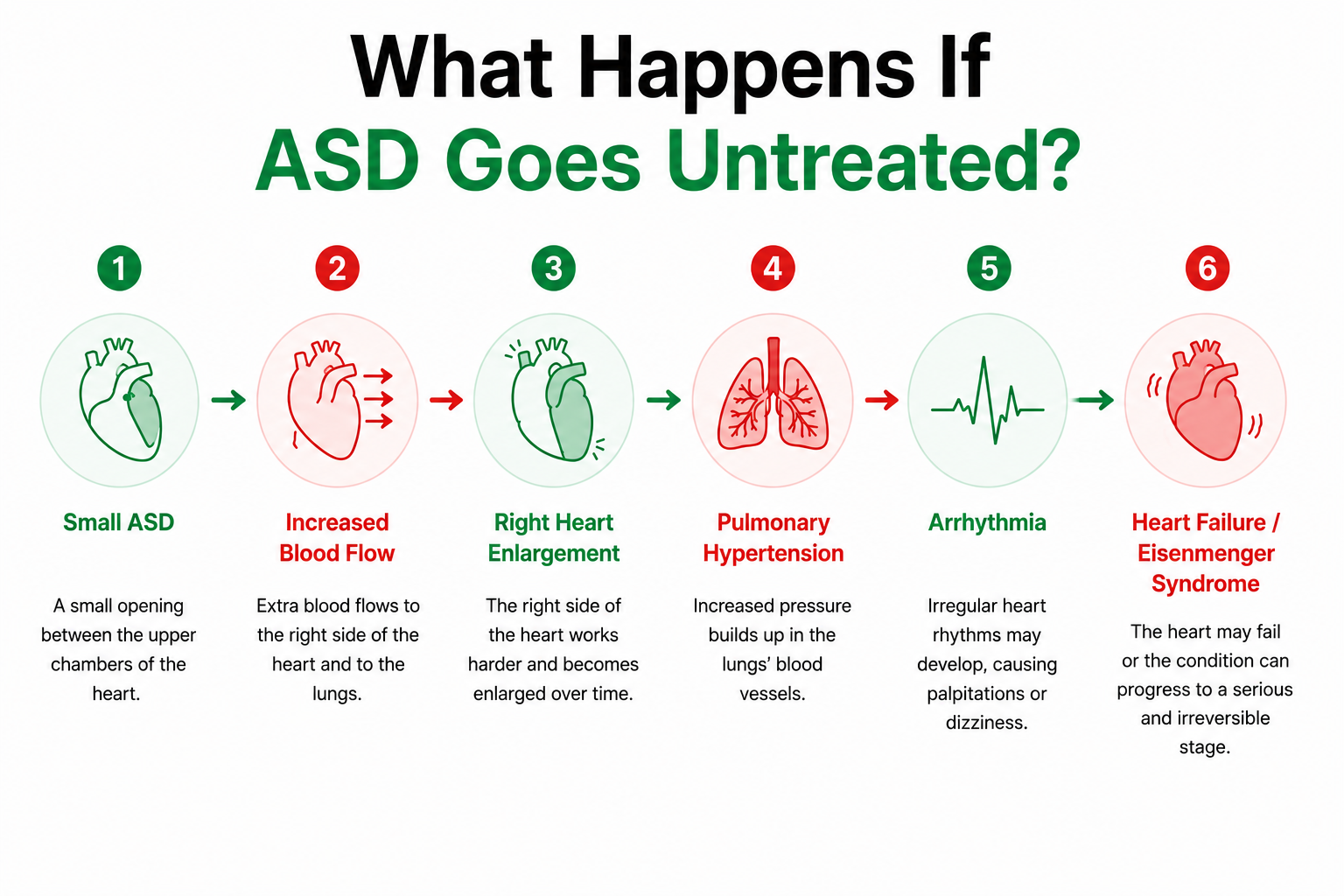 The optimal window for ASD closure is before the age of 25, when the heart retains its greatest capacity to recover and remodel. However, closure in adults well past this age still offers meaningful benefit in most cases, provided pulmonary hypertension has not become fixed.
Recovery After ASD Treatment
After ASD device closure, most patients go home within 1-2 days and resume normal activities within 1-2 weeks. After open-heart surgical repair, hospital stay is 5-7 days with full recovery in 4-6 weeks. Both procedures require antiplatelet or anticoagulant medication and follow-up echocardiography.
After Device Closure
- Hospital stay: Typically 1 to 2 nights
- Return to activity: Most patients resume light daily activity within 3 to 5 days
- Return to work or school: Usually within 1 to 2 weeks
- Physical activity: Strenuous exercise is restricted for 4 to 6 weeks while the device integrates
- Medications: Antiplatelet therapy (aspirin or clopidogrel) is prescribed for approximately 6 months to prevent clot formation on the device while endothelialisation occurs
- Follow-up: Echo at 1 month, 6 months, and 1 year to confirm complete closure and device position
After Open-Heart Surgery
- Hospital stay: 5 to 7 days, including time in the cardiac intensive care unit
- Return to activity: Light activity at home after 2 to 3 weeks
- Return to work: Most adults return between 4 and 6 weeks post-surgery
- Wound care: The chest wound requires standard care; full healing typically takes 6 to 8 weeks
- Medications: As prescribed, including anticoagulants in some patients; specific regimen depends on individual circumstances
- Follow-up: Regular echocardiographic monitoring to assess right heart recovery and patch integrity
Long-term, the vast majority of patients who undergo ASD closure in childhood or early adulthood achieve a normal life expectancy with no significant restrictions on activity.
Atrial Septal Defect Cost Treatment in Delhi
The ASD treatment cost in Delhi ranges from ₹1,25,000 to ₹4,10,000, depending on the type of procedure, the complexity of the defect, and the specific hospital and facilities involved.
| Treatment Type | Estimated Cost Range (INR) |
|---|---|
| Transcatheter Device Closure | ₹1,25,000 – ₹2,50,000 |
| Open-Heart Surgical Repair | ₹2,00,000 – ₹4,10,000 |
Factors that influence the total cost:
- Type and size of the closure device used
- Whether the procedure is minimally invasive or surgical
- Duration of hospital stay and ICU requirement
- Pre-procedure investigations (echo, TOE, ECG, blood work)
- Anaesthesia and catheterisation or operation theatre charges
- Post-operative medications and follow-up consultations
Many health insurance policies in India cover ASD repair when performed for documented clinical indications. Patients are advised to verify their coverage directly with their insurer and obtain a detailed cost estimate from the hospital before the procedure.
Why Patients Choose Dr. Dinesh Kumar Mittal for ASD Treatment in Delhi?
Choosing the best heart surgeon for a congenital heart procedure, particularly for a child, is one of the most significant decisions a family will make. Patients across Delhi NCR and beyond trust Dr. Dinesh Kumar Mittal because of:
- 25+ years of specialist experience in cardiothoracic and vascular surgery
- More than 10,000 cardiac surgeries performed across adult and paediatric patients
- Pioneer of the Neonatal Cardiac Surgery Programme, offering surgical care to the most vulnerable patients from the very earliest days of life
- Expertise in both device closure and open surgical repair of ASD and other congenital defects
- Fellowship in Endovascular Stenting, Milan, Italy, bringing international-standard training to complex structural heart cases
- Active role in developing the Aortic Intervention Programme in North India
- Affiliated with Fortis Hospital, Shalimar Bagh, a tertiary care centre with a fully equipped cardiac surgery and catheterisation facility
- Member of the Indian Association of Cardiovascular Thoracic Surgeons (IACTS), Indian Medical Association (IMA), and Delhi Medical Council (DMC)
Dr. Mittal approaches every patient, child or adult with the same commitment to precise diagnosis, personalised planning, and the safest available technique for their specific anatomy.
Book a Consultation for Atrial Septal Defect Treatment in Delhi
An atrial septal defect may be silent for years, but the longer it is left unaddressed, the more complex the downstream consequences can become. Whether you have been told your child has a heart murmur, have recently been diagnosed with ASD as an adult, or are simply concerned about symptoms like breathlessness or palpitations, a specialist opinion is the most important next step.
During your consultation with Dr. Dinesh Kumar Mittal, you can expect:
- A thorough review of symptoms, clinical history, and any existing investigation reports
- Assessment of echocardiogram findings to determine the type, size, and haemodynamic significance of the defect
- A clear explanation of whether device closure or surgical repair is more appropriate for your specific anatomy
- Honest discussion of what the procedure involves, what recovery looks like, and what outcomes to expect
- Transparent guidance on cost, hospital stay, and insurance
- A personalised care plan, not a one-size-fits-all recommendation
Whether your child needs a device closure or you are an adult seeking a second opinion before deciding on surgery, book a consultation now.
Frequently Asked Questions
At what age should ASD be repaired? expand_more
The ideal window for ASD closure is between the ages of 3 and 5 years in children, before school age, to prevent long-term effects on heart and lung function. However, ASD can be safely closed at any age, including in adults over 60, provided pulmonary hypertension is not at an irreversible stage.
Is ASD repair safe for children? expand_more
Both device closure and open-heart surgical repair of ASD carry excellent safety records in children when performed in specialist centres by experienced surgeons.
Will my child lead a normal life after ASD repair? expand_more
In the vast majority of cases, children who undergo timely ASD repair grow normally, achieve full exercise capacity, and face no long-term restrictions on activity. Adults treated before pulmonary hypertension develops also see substantial improvement in quality of life.
What is Eisenmenger syndrome? expand_more
Eisenmenger syndrome is a severe, late-stage complication of untreated ASD where the elevated pulmonary artery pressure causes the shunt to reverse direction, and unoxygenated blood now flows from the right side to the left.
How do I book a consultation with Dr. Dinesh Kumar Mittal? expand_more
You can book an appointment with Dr. Dinesh Kumar Mittal by contacting Fortis Hospital, Shalimar Bagh, Delhi, directly or using the online appointment booking facility available on this website.

Dr. Dinesh Mittal's Medical Content Team
Dr. Dinesh Kumar Mittal’s medical content team creates clear, reliable, and patient-friendly healthcare information. With a strong understanding of medical concepts and experience in health writing and SEO, the team simplifies complex topics into easy-to-read content. Each resource is designed to help patients better understand their care options and make informed decisions, while aligning with Dr. Mittal’s commitment to quality and transparency in patient care.
This content is reviewed by Dr. Dinesh Kumar Mittal
Related Blogs

What Causes a Hole in the Heart and How is it Treated?
The heart is the powerhouse of the entire body, pumping blood into every cell.…
Read Article → WhatsApp