
Varicose Vein Surgery in Delhi
Varicose veins surgery in Delhi has advanced considerably. Today, most patients can be treated through minimally invasive procedures that require no hospital stay and allow a return to normal activity within days, with no long surgical scar.
Varicose veins are enlarged, twisted veins that bulge visibly beneath the skin, most commonly appearing in the legs and feet. They develop when the small valves inside the veins stop working properly, allowing blood to pool and the vein walls to stretch out of shape. While varicose veins are sometimes dismissed as a cosmetic concern, untreated cases can progress to significant pain, skin changes, and in advanced stages, venous ulcers or deep vein thrombosis (DVT).
Dr. Dinesh Kumar Mittal, Senior Cardiac and CTVS Surgeon at Fortis Hospital, Shalimar Bagh, Delhi, offers comprehensive assessment and surgical treatment for varicose veins, combining ultrasound-guided diagnosis with the most appropriate procedural approach for each patient’s specific vein anatomy and stage of disease.
Request a Consultation
What Causes Varicose Veins?
Varicose veins develop when the vein walls weaken or the valves within them malfunction. Several factors increase this risk:
- Prolonged standing or sitting: Occupations that require long periods on the feet, teachers, surgeons, retail workers, place sustained pressure on leg veins.
- Age: Vein walls and valves naturally weaken over time, making varicose veins more common after the age of 40.
- Gender: Women are more frequently affected, partly due to hormonal changes during pregnancy, the menstrual cycle, and menopause that relax vein walls.
- Pregnancy: Increased blood volume and pressure from the growing uterus are major contributors to varicose veins in younger women.
- Family history: A strong genetic predisposition exists; if both parents have varicose veins, the likelihood of developing them is significantly higher.
- Obesity: Excess body weight increases pressure on the venous system of the legs.
- Prior deep vein thrombosis (DVT): Previous clots can damage the valves in the internal veins, leaving them incompetent.
Varicose Veins Symptoms: What Should You Look Out For?
Varicose veins symptoms vary from person to person and often worsen as the day progresses or after prolonged standing. Common signs include:
- Visible, rope-like, bulging veins on the legs or calves
- Aching, heaviness, or tiredness in the legs, especially towards the evening
- Swelling in the ankles or feet
- Itching or a burning sensation over the affected vein
- Skin darkening or a brownish discolouration around the ankle (lipodermatosclerosis)
- Muscle cramps, particularly at night
- Restless legs or a feeling of throbbing
In more advanced cases, varicose veins symptoms may include open sores or ulcers near the ankle that are slow to heal. At this stage, specialist assessment and treatment are no longer optional.
Do not assume these symptoms are simply “tiredness” or ageing. A Doppler ultrasound with a varicose veins specialist can identify the underlying problem within a single appointment.
Varicose Veins Stages: Understanding Disease Severity
Varicose vein disease is classified using the internationally recognised CEAP system, which stages chronic venous disease from C0 (no visible signs) through to C6 (active venous ulcer). Understanding the varicose veins stages guides treatment decisions:
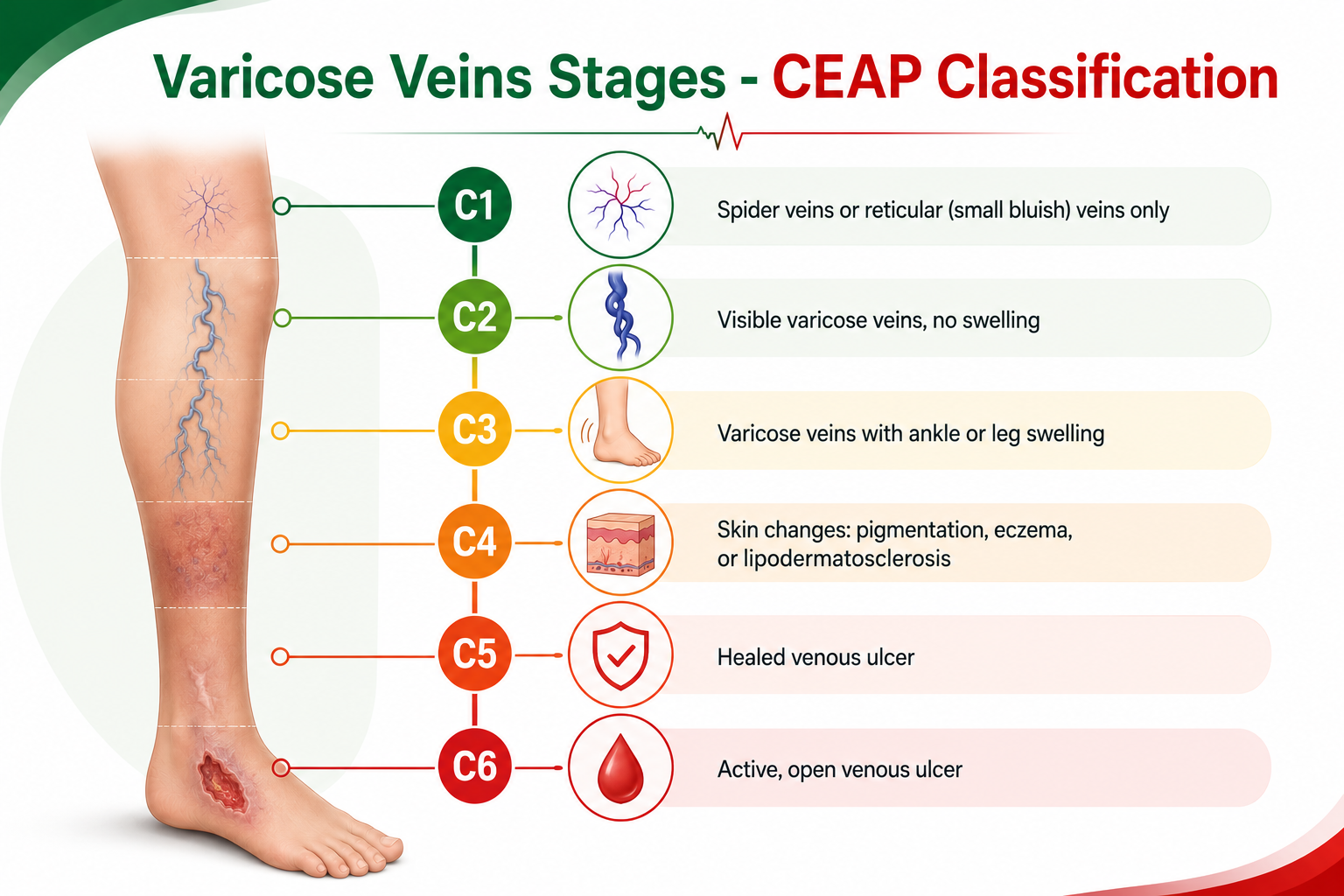
Most patients who come for varicose veins treatment fall between C2 and C4. Intervention at these stages produces the best outcomes and prevents progression to ulceration.
When Is Varicose Vein Surgery Recommended?
Not all varicose veins require surgery. Mild cases (C1-C2) with minimal symptoms may be managed conservatively with compression stockings, leg elevation, and lifestyle changes. Varicose veins treatment through surgical or procedural intervention is recommended when:
- Symptoms significantly affect daily comfort or quality of life
- Swelling, skin changes, or discolouration have developed (C3-C4)
- A venous ulcer is present or has previously occurred (C5-C6)
- Superficial thrombophlebitis (inflammation of a varicose vein) has developed
- Bleeding from a varicose vein has occurred
- Duplex ultrasound confirms significant venous reflux in the great or small saphenous vein
The right time to consult a varicose veins specialist is before symptoms become limiting. Early treatment is simpler, more effective, and significantly reduces the risk of progression.
How Is Varicose Vein Surgery Performed in Delhi?
Each patient receives a personalised varicose veins treatment plan based on their Doppler findings, symptom burden, and individual anatomy. You can learn more about related vascular conditions on the peripheral artery disease page and the deep vein thrombosis page.
The varicose surgery procedure follows a structured pathway from initial assessment to discharge.
Step 1: Duplex Doppler Ultrasound
Before any intervention, a Doppler ultrasound maps the venous system of the leg, identifying exactly which veins are refluxing, their diameter, and the extent of disease. This scan is the foundation of safe, targeted varicose veins treatment.
Step 2: Procedure Planning and Consent
The surgeon reviews the ultrasound findings, explains the recommended technique, and discusses risks, recovery, and costs in detail.
Step 3: Anaesthesia and Tumescent Infiltration
For EVLA and RFA, local anaesthetic (tumescent solution) is injected along the length of the vein. This numbs the area and protects surrounding tissue from heat.
Step 4: Laser or RFA Catheter Placement
Under continuous ultrasound guidance, a thin catheter or laser fibre is introduced into the vein through a needle puncture; no surgical incision is required.
Step 5: Thermal Ablation
The laser or radiofrequency energy is applied as the catheter is slowly withdrawn, sealing the vein along its entire length.
Step 6: Phlebectomy of Tributaries (if required)
Visible tributary veins are removed through micro-punctures at the same sitting.
Step 7: Compression and Discharge
A compression bandage or stocking is applied immediately after the procedure. Most patients walk to their car and are discharged the same day.
Recovery After Varicose Vein Surgery
Recovery from minimally invasive varicose veins surgery is notably swift:
- Same-day discharge is standard for EVLA and RFA
- Walking is encouraged immediately after the procedure, it aids venous return
- Compression stockings are worn for 2 to 4 weeks post-procedure
- Return to desk work: typically within 1 to 3 days
- Return to manual work or strenuous activity: within 2 to 4 weeks
- Follow-up Doppler ultrasound: performed at 6 weeks to confirm vein closure
Conventional surgical stripping requires a hospital stay of 1 to 2 days and a longer return to activity of 2 to 4 weeks.
Risks of Varicose Vein Surgery
Varicose veins treatment, particularly minimally invasive techniques, carries a low complication rate when performed by an experienced varicose veins specialist. Potential risks include:
- Bruising and tenderness along the treated vein resolve within 2 to 4 weeks
- Superficial thrombophlebitis, inflammation in a treated or adjacent vein, managed with anti-inflammatories
- Skin numbness, due to the proximity of small sensory nerves, usually temporary
- DVT (deep vein thrombosis) is rare; reduced by early walking and compression
- Recanalisation, partial reopening of the treated vein over time; monitored with follow-up ultrasound
- Skin burns or pigmentation are uncommon with correctly performed thermal ablation
Risks and expected outcomes are discussed fully during consultation, allowing patients to make an informed decision.
Varicose Vein Surgery Cost in Delhi
The cost of varicose veins treatment in Delhi depends on the technique used, the number of veins involved, and whether one or both legs require treatment.
| Treatment Type | Estimated Cost (INR) |
| Sclerotherapy (per session) | ₹5,000 – ₹25,000 |
| Endovenous Laser Ablation (EVLA) | ₹60,000 – ₹1,20,000 per leg |
| Radiofrequency Ablation (RFA) | ₹40,000 – ₹1,00,000 per leg |
| Ambulatory Phlebectomy | ₹30,000 – ₹60,000 |
| Conventional Vein Stripping Surgery | ₹1,00,000 – ₹2,50,000 |
Pre-procedure investigations (Doppler ultrasound, blood tests) are additional. The final cost is confirmed after Doppler assessment and consultation. Most health insurance policies in India cover varicose veins treatment when performed for documented clinical indications (C2 and above). Patients are advised to confirm cashless eligibility with their insurer before scheduling.
Why Patients Trust Dr. Dinesh Kumar Mittal for Varicose Vein Surgery in Delhi
Choosing the right varicose veins specialist in Delhi means choosing a surgeon who will look beyond the visible vein and treat the underlying venous disease comprehensively. Patients across Delhi NCR choose Dr. Dinesh Kumar Mittal for:
- 25+ years of cardiothoracic and vascular surgical experience
- MCh in Cardiothoracic Surgery, AIIMS New Delhi; India’s highest post-graduate qualification in the field
- Fellowship in Endovascular Stenting, Milan, Italy; directly relevant to catheter-based vascular interventions
- Access to advanced Doppler ultrasound and a fully equipped vascular suite at Fortis Hospital, Shalimar Bagh
- Expertise spanning both minimally invasive laser-based techniques and conventional vascular surgery for complex or recurrent cases
- A transparent, no-unnecessary-intervention approach to patient care
Varicose veins are a vascular condition, not merely a cosmetic one. Comprehensive management, including cardiovascular risk assessment alongside treatment, is what distinguishes specialist vascular care from a cosmetic clinic.
Book a Consultation for Varicose Vein Surgery in Delhi
Varicose veins rarely improve on their own. Without treatment, venous disease typically progresses through the CEAP stages, from visible veins to swelling, skin changes, and eventually ulceration. Early assessment with a varicose veins specialist remains the most effective way to prevent this progression and restore comfort.
During your consultation, Dr. Dinesh Kumar Mittal will provide:
- Full clinical examination of the legs and assessment of varicose veins symptoms
- Review and interpretation of any existing Doppler ultrasound reports
- Assessment of varicose veins stage (CEAP) and severity of venous reflux
- Clear explanation of all varicose veins treatment options, from compression therapy to laser surgery
- A personalised treatment plan based on your vein anatomy, lifestyle, and health
- Transparent discussion of the procedure, recovery timeline, and cost
If your legs ache, swell, or the veins are visibly enlarging, the right step is a specialist opinion, before symptoms limit your daily life.
Frequently Asked Questions
Are varicose veins dangerous if left untreated? expand_more
Varicose veins that are not treated can progress to chronic venous insufficiency, causing persistent swelling, skin discolouration, and, in advanced cases, venous leg ulcers that are difficult to heal.
What is the difference between EVLA and vein stripping? expand_more
Endovenous laser ablation (EVLA) is a minimally invasive procedure performed through a needle puncture under local anaesthesia, with same-day discharge and rapid recovery. Vein stripping is a surgical procedure performed under general anaesthesia that physically removes the vein through small incisions, with a longer recovery period.
Will varicose veins come back after treatment? expand_more
Correctly performed ablation achieves durable results in the majority of patients. Follow-up Doppler ultrasound at 6 weeks and periodically thereafter helps monitor outcomes.
Does health insurance cover varicose vein surgery in India? expand_more
Most health insurance policies in India cover varicose veins treatment when performed for documented clinical indications such as pain, swelling, skin changes, or ulceration. Purely cosmetic treatment of spider veins is generally not covered.
How do I book a consultation with Dr. Dinesh Kumar Mittal? expand_more
You can book an appointment with Dr. Dinesh Kumar Mittal by contacting Fortis Hospital, Shalimar Bagh directly or using their online appointment booking facility.

Dr. Dinesh Kumar Mittal's Content Team
Dr. Dinesh Kumar Mittal's medical content team specialises in creating accurate, clear, and patient-focused healthcare content. With strong clinical understanding and expertise in technical writing and SEO, the team translates complex medical information into reliable, accessible resources that support informed decisions and uphold Dr. Mittal's commitment to quality care.
This content is reviewed by Dr. Dinesh Kumar Mittal
Related Treatments
Related Blogs

Varicose Veins Exercises: Best Movements to Improve Blood Flow
If you are also dismissing varicose veins as just a cosmetic issue, you might need…
Read Article → WhatsApp