
The Race Against the Clock: A Donor Heart’s 95 km Journey to Fortis Shalimar Bagh, Delhi
On Thursday, 17 September 2026, an ambulance left PGIMS Rohtak at 7:40 PM carrying a donor heart and reached Fortis Hospital, Shalimar Bagh at 8:43 PM. The 95 km journey took 63 minutes, with the police departments of Haryana and Delhi supporting the green corridor.
To most people, a heart transplant means one dramatic operation. In reality, it begins hours earlier, with a phone alert, blood-group matching, a surgical team on the road and a police-cleared route. This blog explains how that chain works, why every minute matters in a heart transplant in Delhi, and how you can help.
What Is a Green Corridor for a Donor Heart?
A green corridor is a route that traffic police clear in advance so an ambulance carrying a donor organ can travel without the usual delays. Signals and junctions are managed along the way, so the organ reaches the operating theatre in the shortest possible time.
On this occasion, a dedicated Delhi Traffic Police team from the Northern Range, with inspectors from areas such as Nangloi, Rohini, Narela and Model Town, managed the Delhi stretch. The ambulance was received at the Delhi border at about 8:10 PM. Haryana and Delhi police coordinated the corridor so the ambulance could move without interruption across both states.
How Long Can a Donor Heart Stay Outside the Body?
A donor heart is best transplanted within about four hours of leaving the donor, and doctors try to avoid going beyond six. Without a blood supply, heart cells begin to show stress, so the time outside the body is kept as short as possible.
That is why a 63-minute road journey matters. Every minute saved on the road is a minute gained for the surgical team, who must still prepare the heart and complete a long operation.
What Happened, Step by Step?
The whole operation ran for almost twelve hours, from the first alert at 8:50 AM to the ambulance arriving at 8:43 PM. An alert came through the NOTTO group about a heart for a B-positive recipient. Fortis confirmed a suitable recipient at 9:55 AM, and NOTTO formally allocated the heart at 12:03 PM.
The Fortis team left Delhi at 2:49 PM and reached PGIMS Rohtak at 4:34 PM. Retrieval began at 6:13 PM, the heart was retrieved at 7:20 PM, and the ambulance set off at 7:40 PM.
What Is NOTTO and How Are Donor Hearts Matched?
NOTTO, the National Organ and Tissue Transplant Organisation, is India’s apex body for organ donation and transplantation. It maintains the national donor-recipient registry and links regional and state organisations with hundreds of hospitals. A heart retrieved in one state can therefore reach a patient in another.
Matching depends on factors such as blood group, body size and medical urgency. The need is large.
India recorded a record 20,138 organ transplants in 2025, of which 3,526 came from deceased donors, and more than 2.58 lakh people pledged their organs. Only 239 of the 2025 transplants were heart transplants. In 2024, India’s deceased donation rate was below one per million people, compared with 48 per million in Spain.
Who May Need a Heart Transplant?
A heart transplant is considered when the heart has failed so severely that medicines, devices and other surgeries can no longer support the body. It is usually advised for end-stage heart failure, and every patient goes through detailed assessment first.
Common warning signs of advanced heart failure include:
- Breathlessness even at rest or on light activity
- Swelling in the feet, ankles or abdomen
- Extreme tiredness and reduced ability to walk short distances
- Repeated hospital admissions for heart failure
Not everyone with a weak heart needs a transplant. Many patients do well with medicines, bypass surgery, valve repair or replacement, or temporary support such as ECMO. A specialist review of your scans, angiography and heart function decides the right path.
What Happens After the Heart Reaches the Hospital?
Once the ambulance arrives, the transplant operation begins with a large team of surgeons, anaesthetists, perfusionists, theatre staff and intensive care nurses working in step. After surgery, the patient is closely monitored, and lifelong medicines are usually needed to help prevent the body from rejecting the new heart.
Out of respect for the patient and family, no personal or medical details of the recipient or the donor are shared here.
Who Made This Journey Possible?
A transplant is a chain, and every link has to hold. This one depended on:
- The donor family, who made a generous decision in their hardest hour
- PGIMS Rohtak, whose team supported the retrieval
- NOTTO, which coordinated the allocation
- Haryana Police and Delhi Traffic Police, who cleared 95 km of road
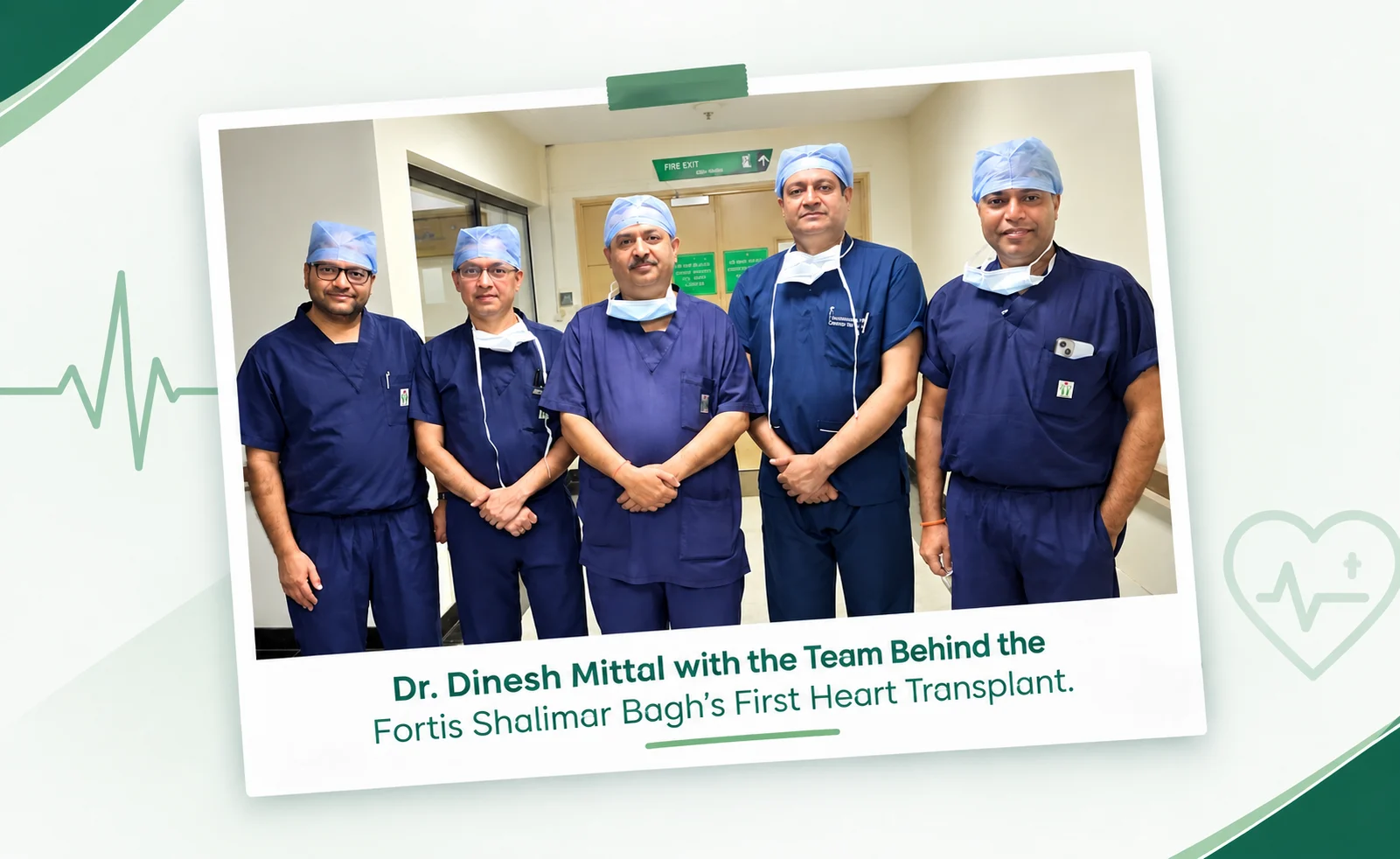
- The Fortis Hospital, Shalimar Bagh team, who prepared through the day
“A heart transplant is never the work of one surgeon or one hospital. It depends on a donor family’s courage, a national allocation system, and police officers who clear the road so that no minutes are lost. If this story makes you think about organ donation, please talk to your family about it today.” – Dr. Dinesh Kumar Mittal, Senior Director and HOD, Cardiothoracic and Vascular Surgery, Fortis Hospital, Shalimar Bagh
Every Transplant Begins With a Yes: How to Pledge Your Organs
You can pledge to donate your organs in a few minutes on the official NOTTO portal, and the most important step afterwards is telling your family. Consent is sought from them at the time of donation, so their knowing your wish makes it far easier to honour.
Here is how to do it:
- Open the official NOTTO pledge page.
- Sign in or register with your basic details.
- Choose which organs and tissues you wish to donate.
- Submit the form and keep your copy of the pledge.
- Share your decision with your family, ideally today.
NOTTO’s own pledge form stresses that organ donation is a family decision, which is why that last step matters as much as the pledge itself.
The 63-minute journey from Rohtak to Shalimar Bagh was possible because a donor family said yes, a national network matched the heart, and police cleared 95 km of road, but the story began with that first yes. More than 2.58 lakh people pledged in 2025, and every additional pledge, backed by a family that knows your wishes, can shorten a waiting list.
If you or someone you love is living with heart failure, you do not have to wait for a crisis to get answers. An early conversation with a specialist can clarify what treatment is right for you.

 WhatsApp