
Atrial Septal Defect Repair in Delhi
Treatment for an atrial septal defect (ASD), commonly called a hole in the heart, depends on how big the hole is, and where it sits in the heart. A small hole that does not strain the heart may only need regular check-ups. A larger one may need closing. In India, about 56 out of every 100,000 babies are born with an ASD, making it the second most common heart defect at birth. For atrial septal defect repair in Delhi, Dr. Dinesh Kumar Mittal is one of the trusted names.
With training in cardiothoracic and vascular surgery at AIIMS, New Delhi and more than 25 years of heart surgical experience, he is the head of Cardiothoracic and Vascular Surgery at Fortis Hospital, Shalimar Bagh. His work spans adult, paediatric and neonatal cardiac surgery, including minimally invasive cardiac surgery.
This page explains how the hole affects the heart, the symptoms to look for, how it is diagnosed, how closure works and what it costs.What Is Atrial Septal Defect (Hole in the Heart)?
Request a Consultation
What Is Atrial Septal Defect (Hole in the Heart)?
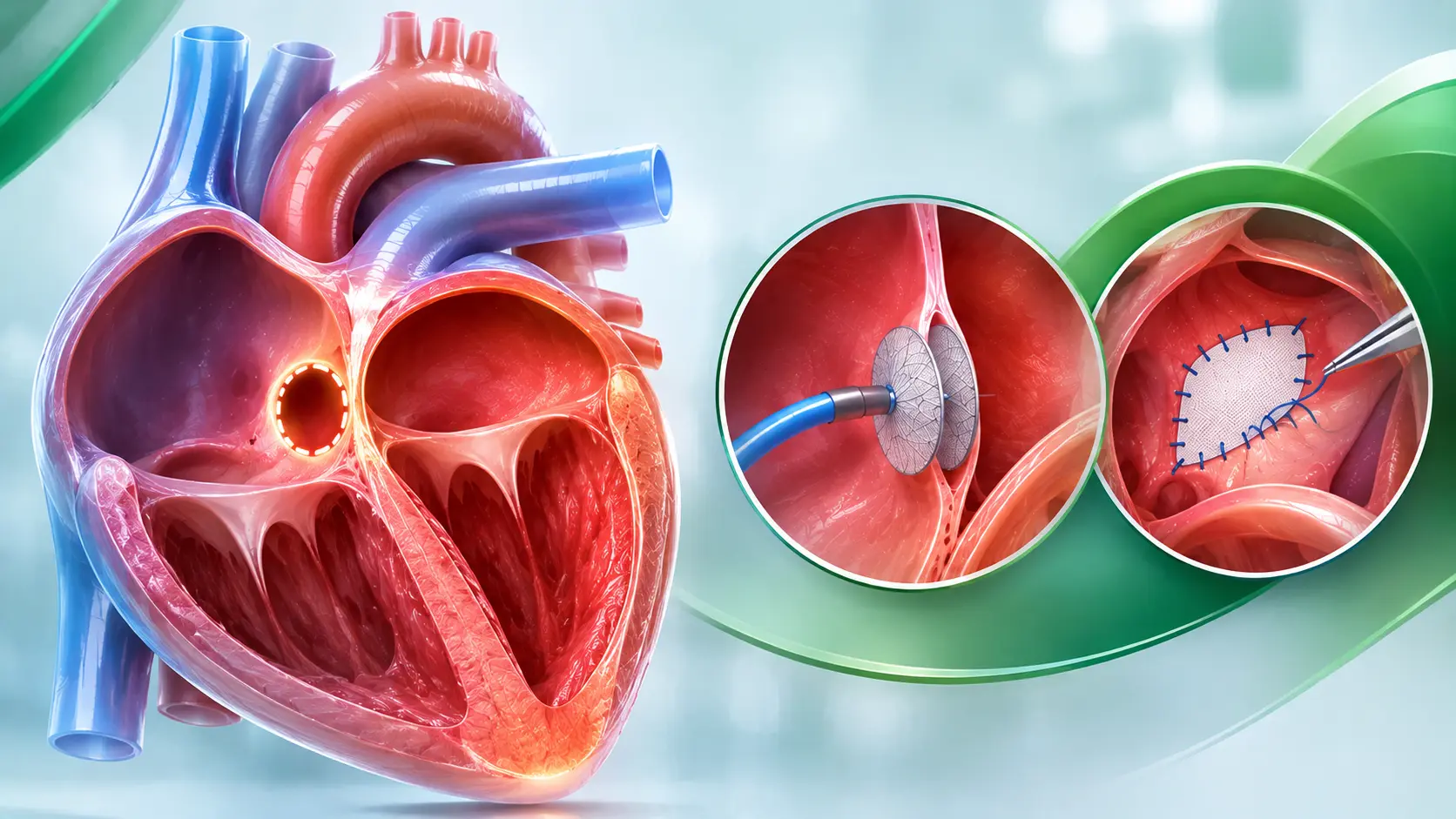
An atrial septal defect (ASD), also called a hole in the heart, is an opening in the wall between the heart’s two upper chambers. A baby is born with it, so it is a congenital heart defect.
- The heart is a pump with four chambers: two upper ones (atria) and two lower ones (ventricles).
- The right side sends oxygen-poor blood to the lungs.
- The left side pumps oxygen-rich blood to the body.
- A wall called the septum keeps the two sides apart.
In an ASD, part of this wall does not form fully and appears as a hole.
Types of ASD: Where the Hole Sits
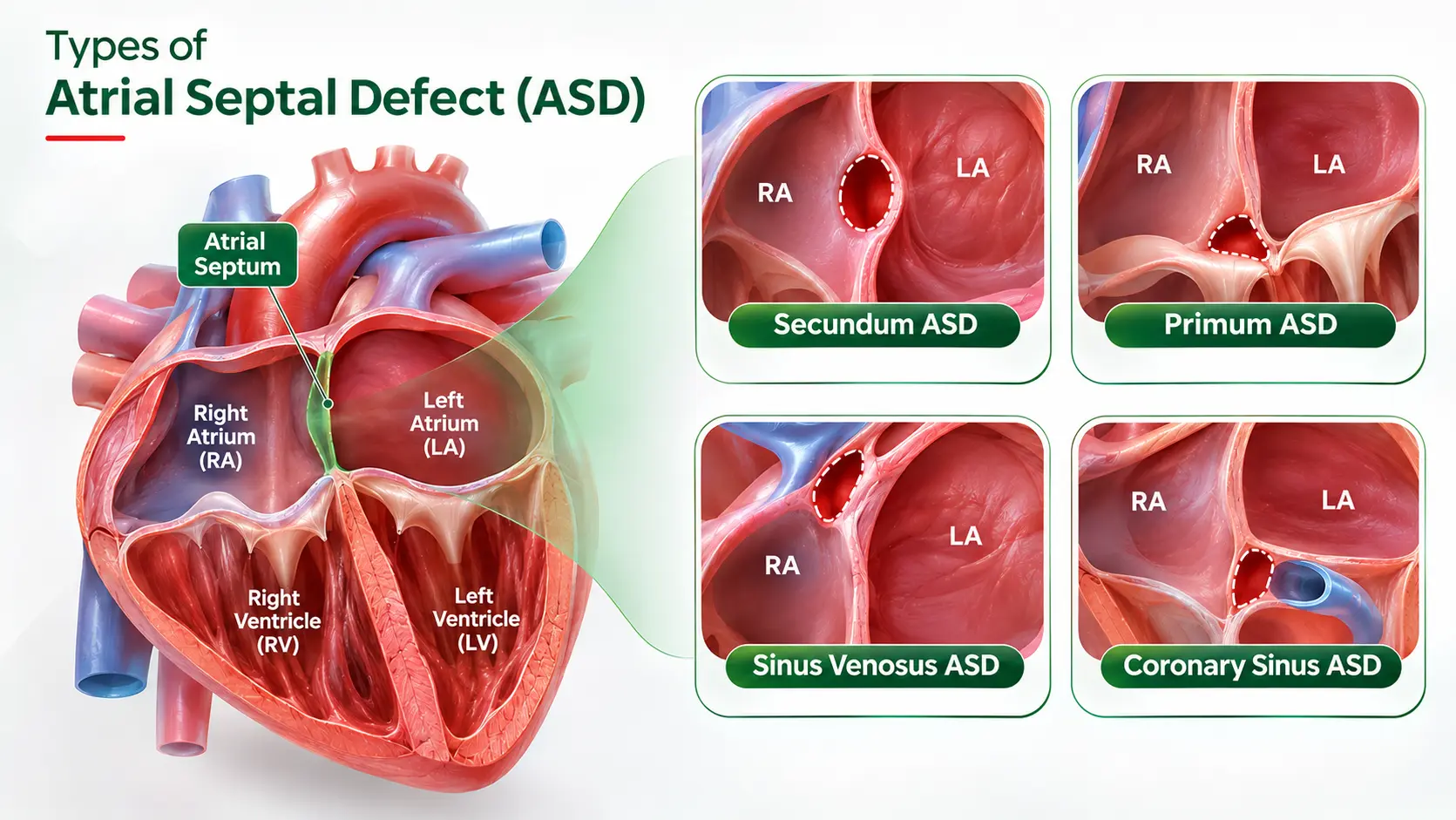
There are four types of atrial septal defect. The most common type is secundum, and the others are primum, sinus venous and coronary sinus.
| Type | Location | Usual treatment option |
| Secundum | Middle of the wall | Device if the edges (rims) are firm; surgery if not |
| Primum | Lower wall, near the valves | Usually surgery |
| Sinus venosus | Upper wall, near the large vein from the body | Usually surgery |
| Coronary sinus | Back wall, near a small heart vein | Usually surgery |
In a study of 101 infants whose holes were found in the first 3 months of life, 87 closed on their own. That included all 32 holes under 3 mm and 39 of 45 holes of 3 to 5 mm. Of 20 holes of 5 to 8 mm, 16 closed; none of the 4 holes of 8 mm or more did.
Hole in Heart in Symptoms
The symptoms of a hole in the heart include breathlessness, unusual tiredness, palpitations and swollen feet, but many people have none for years. In children, the first clue is often a heart murmur heard through a stethoscope. ASD symptoms in adults usually appear in the 30s and 40s, after years of extra blood flow have strained the heart and lungs.
- Breathlessness on walking or climbing stairs
- Unusual tiredness
- A racing or skipping heartbeat
- Swelling of feet, legs or belly
- Repeated chest infections
- In babies: tiring easily during feeds, slow weight gain, a murmur heard through stethoscope
See a heart specialist if you notice these signs. Sudden weakness on one side, trouble speaking, chest pain, fainting or blue lips in a baby need emergency care at once.
Atrial Septal Defect Diagnosis
An echocardiogram (echo), an ultrasound of the heart is usually the first test. Further tests depend on what the echo shows:
- Echocardiography (echo): a chest ultrasound with no cut or needle. Usually the first test, it shows the hole’s size, position, blood flow direction and if the right chambers are stretched.
- ECG: records the heart’s electrical signals to show rhythm problems.
- Chest X-ray: shows if the heart has grown larger and if the lung blood vessels look crowded by extra blood.
- TEE (transoesophageal echocardiography): A thin ultrasound probe goes down the food pipe, usually under sedation. It lies right behind the heart, so it shows the hole’s exact size and rims (the edges of tissue around it) more sharply.
- Catheterisation: a thin tube passed through a vein measures pressure and oxygen levels in the heart and lungs.
- CT or MRI: gives detailed 3D pictures when the defect is complex or other blood vessels are involved.
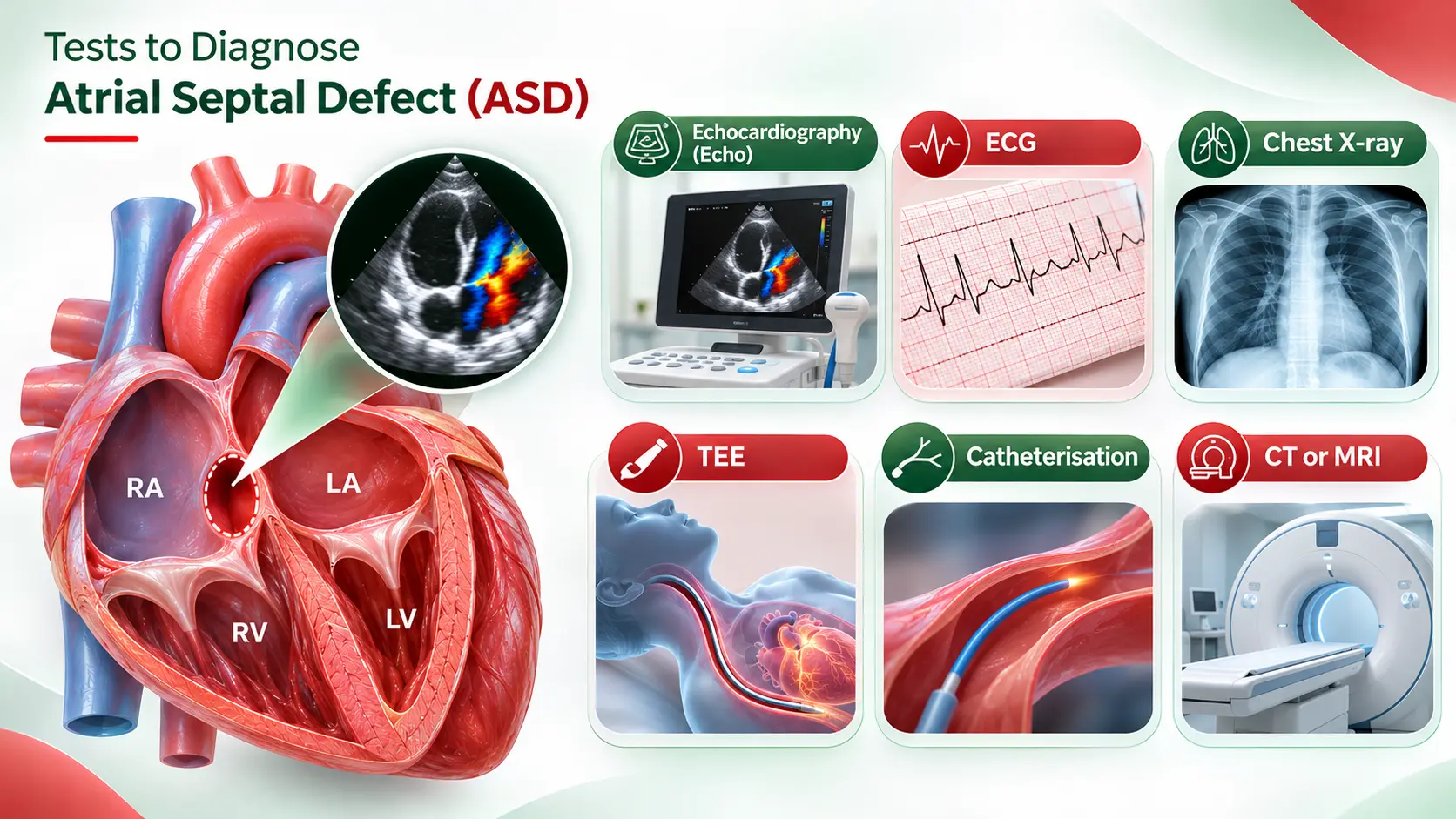
Together, these results decide if the hole in the heart needs only watching, a device or surgery.
Hole in Heart Treatment (Atrial Septal Defect Treatment)
ASD treatment follows one of three paths: regular follow-up, a device closure, or surgery. Medicines cannot close the hole, but they can ease symptoms such as breathlessness or a fast heartbeat.
Follow-up with regular echo checks
- It suits small holes that do not strain the heart.
- Regular echo scans show if the hole or the heart chambers are changing.
ASD device closure (hole in heart treatment without surgery)
- No chest is opened.
- A thin tube carries the device through a groin vein to the heart.
- The device opens across the hole like two small discs
- The heart’s own tissue slowly covers it, closing the hole.
- Mainly suits secundum ASD.
ASD closure surgery
- The chest is opened under anaesthesia.
- A heart-lung machine runs the heart briefly.
- The hole is closed with stitches or a patch.
- Used for very large holes, weak rims, or when other heart repairs are needed too.
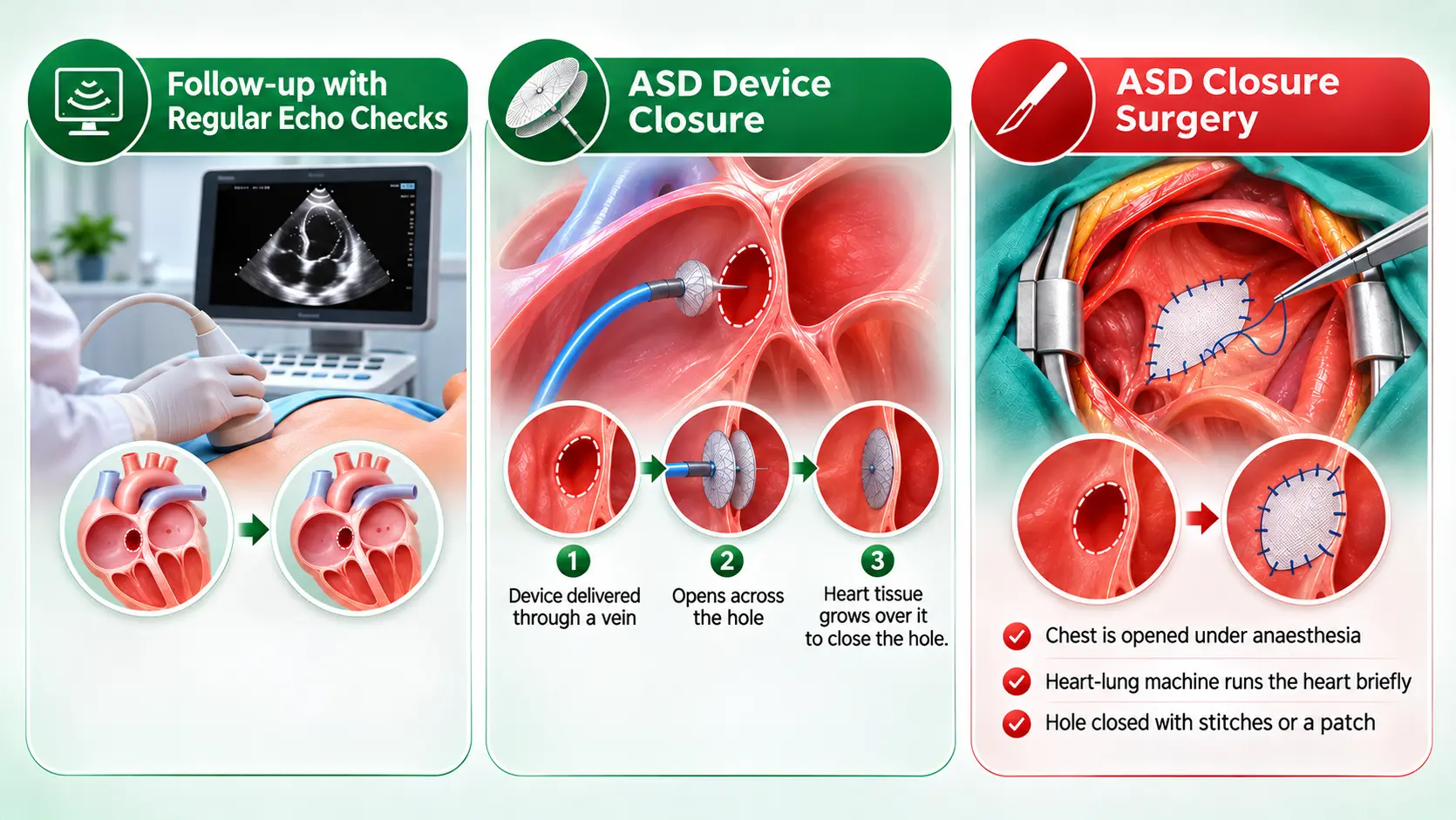
After any of these routes, regular check-ups confirm that the heart is settling well.
ASD Closure Recovery time
Recovery after ASD closure depends on the route and on the person. A device closure usually needs a shorter hospital stay and a quicker return to routine than open surgery.
| Route | Hospital stay | Return to routine |
| ASD device closure | Usually shorter | Often sooner, as no chest is opened |
| ASD closure surgery | Usually longer, with ICU care first | Takes weeks, as the breastbone needs time to heal |
Your doctor decides when you can go home, return to work and restart exercise, after checking you.
ASD Closure Recovery tips
ASD closure recovery tips are simple: take your medicines on time, build activity slowly, protect the wound, and report warning signs early
- Take medicines as advised; some devices need blood thinners for a set period.
- After surgery, avoid heavy lifting until your doctor clears you.
- Walk short distances daily, with rest in between.
- Keep the wound clean and dry.
- Report fever, breathlessness, swelling, palpitations or chest pain at once.
Keep every follow-up visit, as the echo scans decide when full activity and sports are safe.
Atrial Septal Defect Repair in Delhi Cost
The cost of hole in the heart treatment in Delhi ranges from about Rs 84,000 to Rs 1,10,000 for closure and the final bill changes with the hospital, room and days of stay.
| Treatment | Reference rate (CGHS) |
| ASD device closure | Rs 84,065 to Rs 98,900 |
| ASD closure surgery | Rs 93,500 to Rs 1,10,000 |
The final bill also depends on:
- Size and type of the hole
- Tests before treatment
- Room category, ICU and days in hospital
- Medicines and follow-up scan.
A final estimate can only be given by your doctor after a proper evaluation.
Planning Atrial Septal Defect Repair in Delhi: Dr. Dinesh Kumar Mittal
Dr. Dinesh Kumar Mittal is Senior Director and Head of Cardiothoracic and Vascular Surgery at Fortis Hospital, Shalimar Bagh, Delhi, and treats ASD in children and adults. His training and surgical work are listed below.
- M.Ch (CTVS) from AIIMS, New Delhi
- MS (General Surgery) and MBBS from JLN Medical College, Ajmer
- 20 years of experience
- Over 5,000 adult and paediatric cardiac surgeries
- Helped establish a Neonatal Cardiac Surgery Program
- Treats congenital heart defects such as ASD closure and VSD closure, along with valve, bypass and aortic surgery
His work spans newborns to adults, which matters because an ASD can be found at any age.
What to Expect at First Visit for Atrial Septal Defect Repair in Delhi
The first visit for atrial septal defect repair in Delhi is an evaluation. The doctor checks your heart and reports to decide if the hole needs watching, a device or surgery.
- Questions about your symptoms
- A heart check for a murmur (an extra whooshing sound)
- A review of your echo, ECG and X-ray reports
- Bring: previous reports and your medicine list
- Appointments can be requested through his website.
Writing your questions down beforehand helps you cover everything.
Sources:
- Cardiological Society of India. Consensus statement on atrial septal defect management. Indian Heart Journal. 2019.
View source - American College of Cardiology (ACC) and American Heart Association (AHA). 2018 AHA/ACC Guideline for the Management of Adults With Congenital Heart Disease.
View source - Society of Thoracic Surgeons (STS). Atrial Septal Defect.
- Centers for Disease Control and Prevention (CDC). Atrial Septal Defect.
Frequently Asked Questions
What are the risks of ASD device closure and surgery? expand_more
Device closure can cause poor fit, irregular heartbeat, blood clots or groin bleeding. Surgery can cause bleeding, infection, irregular heartbeat or fluid around the heart, along with anaesthesia risks.
What is the life expectancy of a person with a hole in the heart? expand_more
It depends on the size of the hole and when it is treated. Small holes may cause no problems, but a large untreated hole can strain the heart and lungs over the years.
What is the difference between ASD and VSD? expand_more
An ASD is a hole between the upper chambers (atria). A VSD, ventricular septal defect, is a hole between the lower chambers (ventricles). Evaluation and plans differ.
Can an adult live with a hole in the heart without treatment? expand_more
Some small holes are only watched for years. A larger hole can slowly strain the right heart and lungs, so an echo and specialist review decide if closure is needed.
How do I book a consultation? expand_more
You can book your consultation through his website: drdineshkumarmittal.com.

Dr. Dinesh Kumar Mittal's Content Team
Dr. Dinesh Kumar Mittal's medical content team specialises in creating accurate, clear, and patient-focused healthcare content. With strong clinical understanding and expertise in technical writing and SEO, the team translates complex medical information into reliable, accessible resources that support informed decisions and uphold Dr. Mittal's commitment to quality care.
This content is reviewed by Dr. Dinesh Kumar Mittal
Related Blogs

What Causes a Hole in the Heart and How is it Treated?
The heart is the powerhouse of the entire body, pumping blood into every cell.…
Read Article → WhatsApp