
ECG Test: What It Measures and Why It Matters?
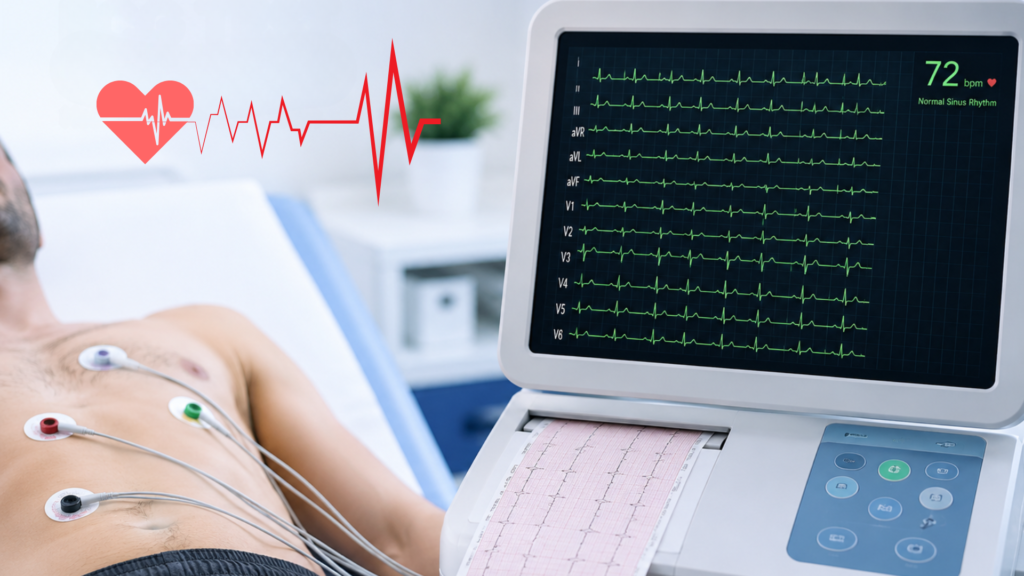
Most people have had an ECG at some point, perhaps before a surgery, after chest discomfort, or as part of a routine health check. Yet very few patients leave the room fully understanding what was just measured, or why their doctor ordered it in the first place.
An ECG test is one of the most commonly performed cardiac investigations worldwide. It is quick and painless, and it provides information about the heart that no physical examination alone can reveal.
Understanding what an ECG test is, how it is done, and what the results mean can help you engage more confidently with your own heart health.
Request a Consultation
What Is an ECG Test?
An ECG (electrocardiogram) is a non-invasive test that records the electrical activity of the heart. Every time the heart beats, it produces a small electrical impulse. An ECG captures those impulses in real time and plots them as a series of waves on a graph. This recording allows a doctor to assess the heart’s rhythm, rate, and overall electrical function.
The test itself takes between five and ten minutes. It involves no needles, no radiation, and no discomfort. Small adhesive electrodes are placed on the chest, arms, and legs, and the machine does the rest.
Why Is an ECG Test Done?
An ECG test is done to investigate or monitor a wide range of heart conditions. It is one of the first tests a cardiologist or cardiac surgeon will request when a patient presents with any cardiac symptom.
Common reasons an ECG is recommended include:
- Chest pain or tightness, particularly on exertion
- Palpitations or a feeling that the heart is racing, fluttering, or skipping
- Unexplained breathlessness or fatigue
- Dizziness, light-headedness, or fainting episodes
- Pre-operative cardiac assessment before surgery
- Routine screening in patients over 40, especially those with diabetes, high blood pressure, or a family history of heart disease
- Monitoring of a known heart condition, such as coronary artery disease or atrial fibrillation
According to the World Health Organisation, cardiovascular disease remains the leading cause of death globally, accounting for an estimated 17.9 million deaths each year. In India, the burden is particularly significant, with heart disease affecting people at younger ages compared to Western populations. An ECG is often the first test to detect these problems before they escalate.
One patient who visited Dr Mittal after weeks of dismissing a racing heartbeat later recalled: “I kept telling myself it was just stress. My wife finally pushed me to get checked. The ECG took about five minutes and showed an irregular rhythm I had no idea about. I was glad I didn’t wait any longer.”
What Does an ECG Test Show?
An ECG test can reveal a great deal about how the heart is functioning electrically. It does not directly show blockages, but the patterns it captures reflect the downstream effects of many conditions.
An ECG test can show:
- Heart rate: Whether it is too fast (tachycardia), too slow (bradycardia), or within a normal range
- Heart rhythm: Whether the heart is beating in a regular or irregular pattern
- Atrial fibrillation: An irregular and often rapid rhythm that increases stroke risk
- Evidence of a previous or ongoing heart attack: Characteristic changes in the ECG waveform indicate areas of the heart that have been damaged or are currently under stress
- Left ventricular hypertrophy: Thickening of the heart muscle, often caused by longstanding high blood pressure
- Conduction abnormalities: Disruptions in the electrical pathways that control heartbeat timing
- Electrolyte imbalances: Abnormal potassium or calcium levels can produce recognisable ECG changes
It is important to understand what an ECG does not show. A normal ECG does not rule out coronary artery disease. Some patients with significant blockages may have a completely normal resting ECG. If symptoms persist despite a normal result, further investigations such as a stress test, echocardiogram, or coronary angioplasty evaluation may be recommended.
Dr Dinesh Kumar Mittal notes, “A normal ECG is good news, but it is not a green light to ignore symptoms. I have seen patients with entirely normal resting ECGs who had significant coronary disease. The ECG is one piece of the puzzle, not the whole picture.”
How Is an ECG Test Done?
An ECG test is straightforward and requires no preparation in most cases. Here is what to expect:
- You will be asked to lie still on an examination table
- A technician places ten small electrodes on specific locations on your chest, arms, and legs
- The electrodes are connected by wires to an ECG machine
- The machine records the electrical signals over approximately ten seconds
- The results are printed as a graph or reviewed on a digital screen
The entire process from start to finish takes under ten minutes. There is no discomfort, no breath-holding, and no exposure to radiation. You simply need to remain as still as possible during the recording, as movement can affect the trace.
ECG Test Results: What Do the Waves Mean?
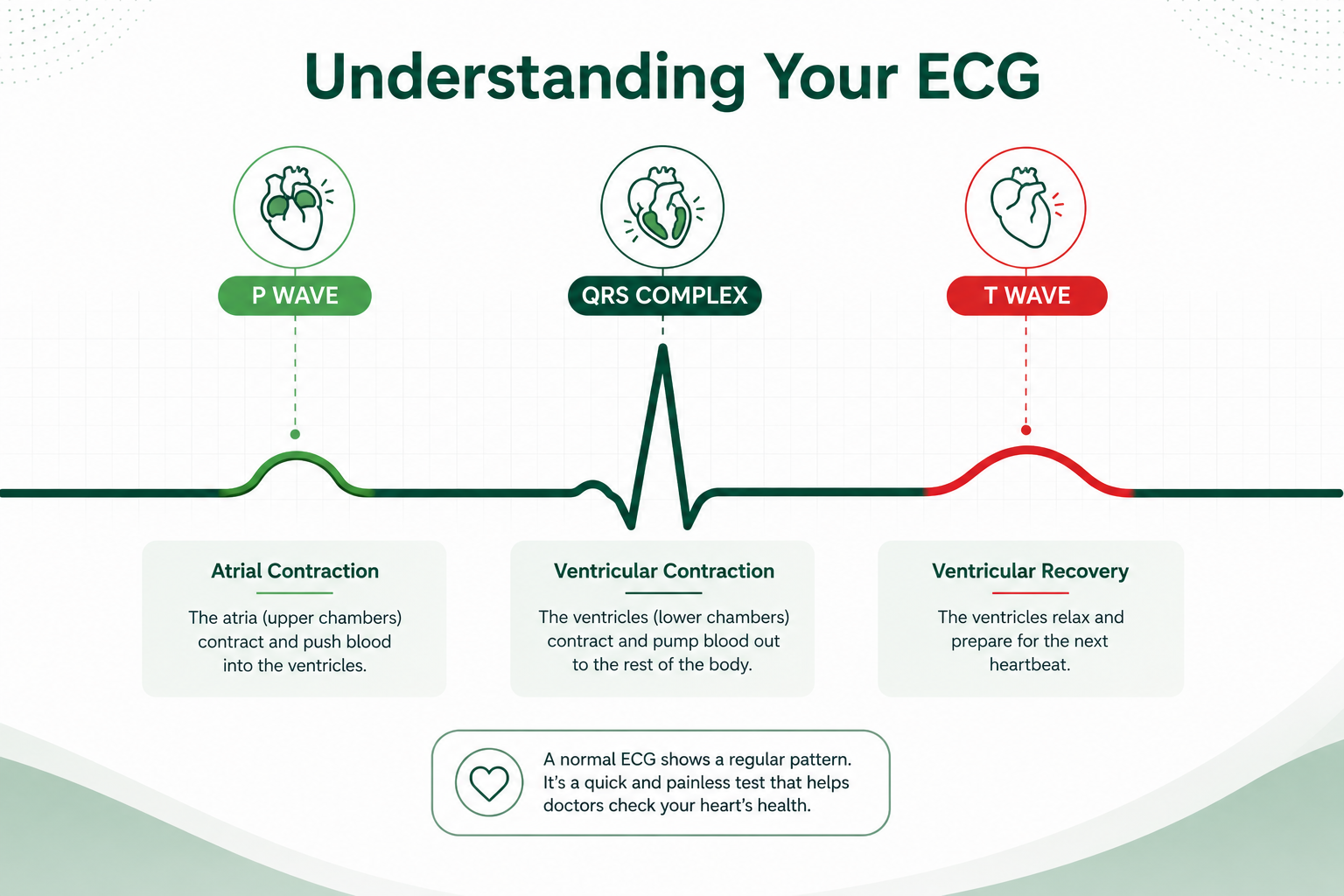
An ECG result displays a series of labelled waves. Each wave corresponds to a specific electrical event in the cardiac cycle.
- P wave: Represents the electrical activation of the upper chambers (atria), triggering their contraction
- QRS complex: Represents the electrical activation of the lower chambers (ventricles), which pump blood out to the body and lungs
- T wave: Represents the electrical recovery of the ventricles before the next beat
Doctors analyse the shape, height, duration, and intervals between these waves to identify abnormalities. A trained eye can read significant clinical information from changes that appear subtle on paper.
ECG Test Normal Range: What Should a Normal ECG Look Like?
A normal ECG result reflects a heart that is beating in a regular rhythm at an appropriate rate, with normal-sized chambers and intact electrical pathways.
Key ECG normal range values include:
| Parameter | Normal Range |
| Heart rate | 60-100 beats per minute |
| PR interval | 120-200 milliseconds |
| QRS duration | Less than 120 milliseconds |
| QT interval | 350-440 milliseconds (adjusted for rate) |
| Rhythm | Regular sinus rhythm |
An ECG result that falls outside these ranges does not always indicate a serious problem. Context matters enormously. An athlete may have a resting heart rate of 45 beats per minute, which appears as bradycardia on paper but is entirely normal for them. Your doctor will always interpret your ECG in the context of your symptoms, age, and medical history.
When Should You Not Ignore Your ECG Results?
If your ECG test results show any of the following, a prompt follow-up with a cardiac specialist is essential:
- ST-segment elevation may indicate an active heart attack requiring urgent intervention
- A new left bundle branch block can signal serious underlying heart disease
- A prolonged QT interval is associated with a risk of dangerous arrhythmias
- Atrial fibrillation requires assessment for stroke risk and rhythm management
- Significant Q waves may indicate previous myocardial damage
Patients with coronary artery disease, cardiomyopathy, or a history of heart attack should have ECG monitoring as part of their regular follow-up, not just during acute episodes.
An ECG is a starting point, not the final word. Its real value lies in guiding the next steps: whether reassurance, lifestyle advice, medication, or a more detailed investigation such as open-heart surgery evaluation or CABG assessment.
As Dr Dinesh Kumar Mittal puts it, “The ECG doesn’t give us all the answers, but it always asks the right questions. That is why it remains the starting point for almost every cardiac evaluation I do.”
When to See a Cardiac Specialist About Your ECG
If you have had an ECG and are unsure what the results mean, or if you have been told the results are abnormal, the next step is a specialist opinion.
Dr Dinesh Kumar Mittal, Director and Head of Cardiothoracic and Vascular Surgery at Fortis Hospital, Shalimar Bagh, Delhi, reviews ECG findings in the context of your full cardiac picture, including symptoms, risk factors, and any supporting investigations.
A single test rarely tells the whole story, but it is often where the right story begins.
The ECG Is a Conversation Starter, Not a Verdict
A five-minute test cannot tell you everything about your heart, but it can tell you enough to know whether the conversation with your doctor needs to go further.
For most people, an ECG brings reassurance. For some, it opens a door that genuinely needed opening, catching an arrhythmia that had gone unnoticed for years, or flagging changes that point to something worth investigating before it becomes urgent.
Either way, the value of an ECG lies not in the paper it prints, but in what a specialist does with it. If you have had an ECG and are still carrying unanswered questions about the results, that is reason enough to seek a proper opinion.
Your heart deserves more than a guess.

 WhatsApp