
Heart Bypass Surgery Success Rate
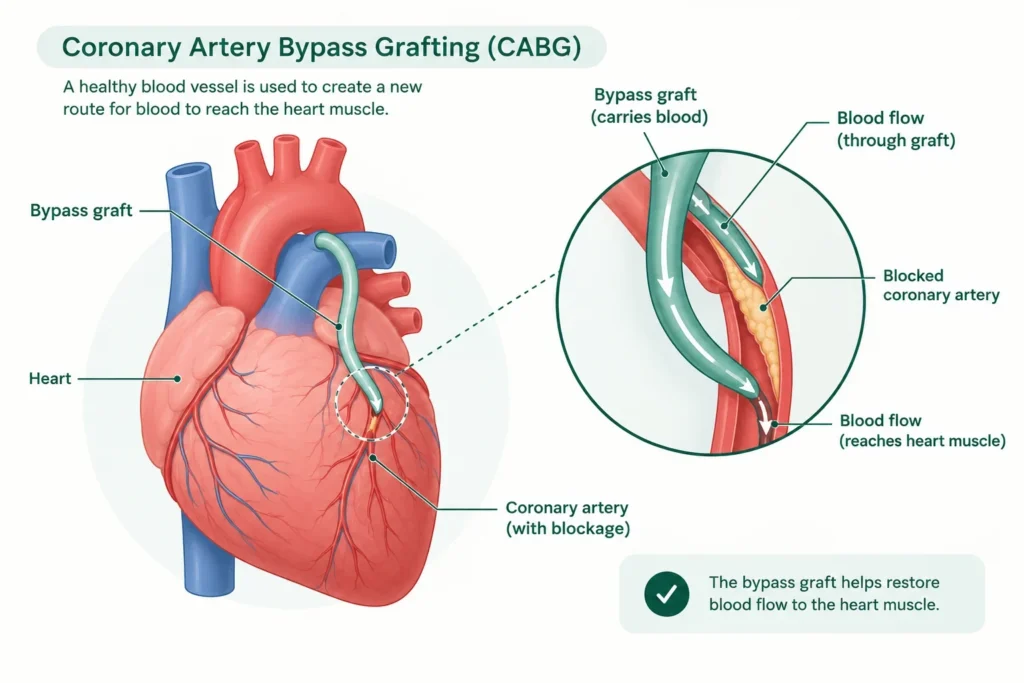
Heart bypass surgery (CABG) has a 95-98%+ success rate in planned, non-emergency cases. The 30-day mortality for elective surgery is typically 1-2% at experienced centres. Long-term survival is around 92% at 1 year, 85% at 5 years, and 75% at 10 years. Most patients – more than 8 in 10 – become free of angina symptoms after surgery. Age, comorbidities, and the surgeon’s experience are the biggest variables.
Request a Consultation
What Is Heart Bypass Surgery (CABG)?
Coronary Artery Bypass Grafting – almost everyone calls it CABG (pronounced “cabbage”) or simply bypass surgery – is the most commonly performed major heart operation in the world.
The idea is straightforward. Coronary arteries are the vessels that supply blood to the heart muscle itself. When fatty deposits (plaque) build up inside them, blood flow slows or stops. The result can be crushing chest pain (angina), a heart attack, or worse.
CABG creates a detour. The surgeon takes a healthy blood vessel – usually from the leg (saphenous vein), the chest wall (internal mammary artery), or the forearm (radial artery), and uses it to bypass the blocked segment. Blood can now reach the heart muscle again via this new route.
A single bypass addresses one blocked artery. A double, triple, or quadruple bypass addresses two, three, or four blockages, respectively. The procedure typically takes 3-6 hours under general anaesthesia.
Modern techniques include:
- On-pump CABG – the heart is temporarily stopped; a heart-lung machine maintains circulation.
- Off-pump CABG – the surgeon operates on a beating heart, avoiding the bypass machine.
- Minimally invasive CABG – smaller incisions between the ribs, less trauma, faster recovery.
CABG has been performed since the 1960s. Decades of refinement have made it one of the most studied and reliable procedures in all of medicine.
What Is the Success Rate of Bypass Surgery?
“Success rate” means different things depending on what you measure. Most patients want to know: Will I survive the operation? And how long will the results last? Here is what the published data actually shows.
Overall Success Rate
The 30-day operative success rate for elective CABG is 98-99% in contemporary series at experienced centres. That means fewer than 1-2 patients in 100 die within 30 days of a planned bypass operation.
Data from Columbia University’s cardiac surgery programme (using New York State’s 2016–2018 outcomes report) recorded an overall 30-day CABG mortality of 1.48% across the state – and as low as 0.72% at their own centre. In other words, the bypass surgery success rate at high-volume academic hospitals is consistently above 98%.
For emergency CABG – performed during or immediately after a heart attack – the risk is higher, typically 3-5%. This is why elective (planned) surgery, when clinically appropriate, is strongly preferred.
CABG also relieves symptoms reliably. Cleveland Clinic reports that the procedure eliminates or dramatically reduces angina in 8 out of 10 patients.
Long-Term Survival Rates
Surviving the operation is one thing. Living well for years afterward is what patients really care about. Here is what the long-term data shows:
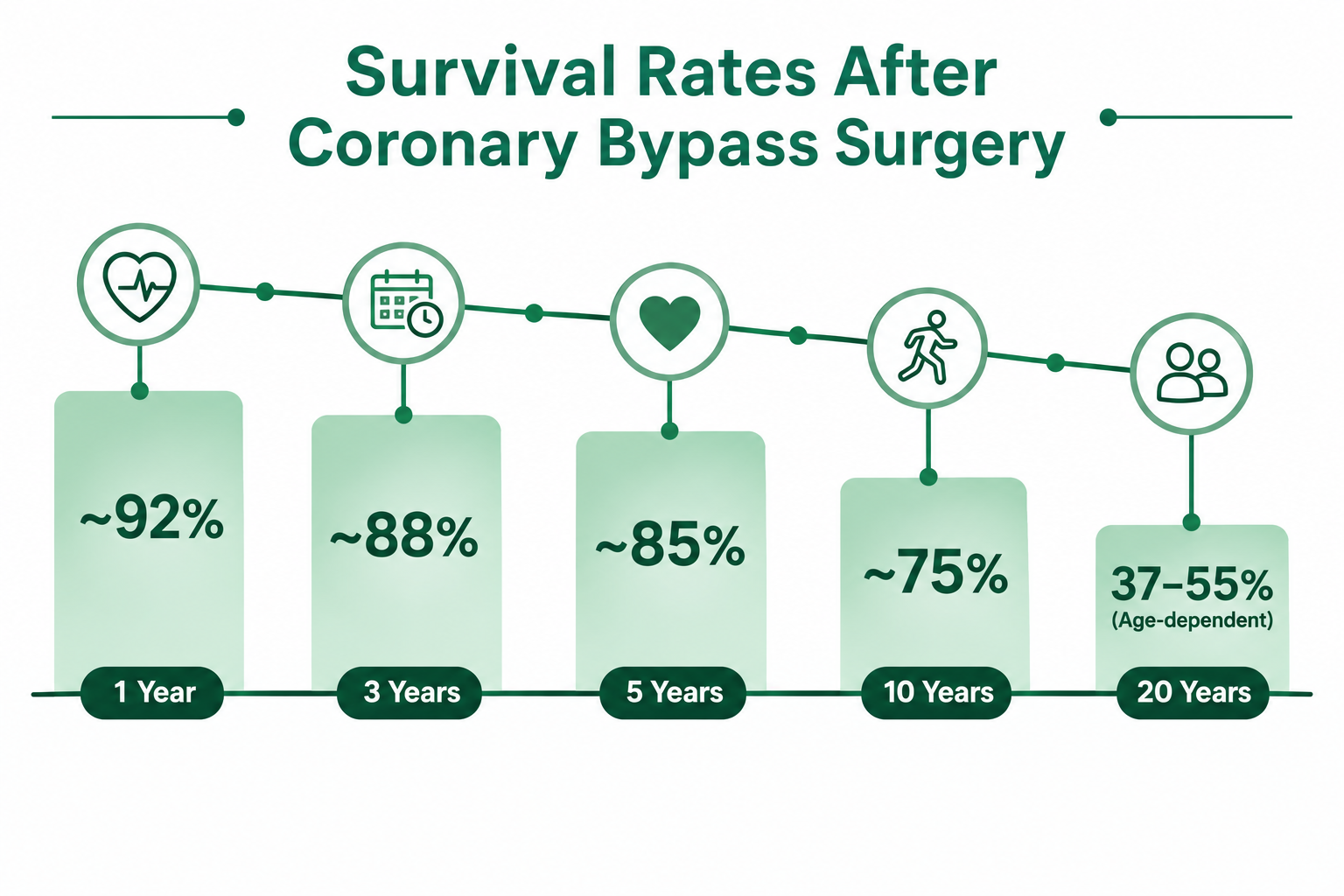
A study published in PMC/NCBI (PMC9137217) reported 1-year survival of 92.4% and 3-year survival of 88.4% in a CABG cohort. Five-year survival in most published series sits around 85%.
The 20-year picture, drawn from a large Circulation (AHA Journals) analysis, shows overall 20-year survival of approximately 35–40% – but this varies enormously by age at surgery: ~55% for patients under 50, dropping to ~11% for those over 70 at the time of operation. It is critical to understand that these long-term numbers reflect the natural progression of underlying heart disease and aging – not a “failure” of the bypass itself.
One study cited by Cleveland Clinic found a median life expectancy of 18 years after bypass surgery.
Success Rate in India
India’s top cardiac centres – including AIIMS Delhi, Escorts Heart Institute, Fortis, and Apollo, Max – report outcomes that are comparable to international benchmarks for elective, low-risk patients.
An Indian study of septuagenarians (patients in their 70s) undergoing isolated CABG reported an in-hospital mortality of just 1.5%, demonstrating that good outcomes are achievable even in older Indian patients at experienced centres.
For higher-risk groups – those with poor heart pump function (low ejection fraction) or ischemic cardiomyopathy – Indian data shows 1-year survival around 86-87% and 5-year survival around 79-80%, which is consistent with global figures for similar patient profiles.
The success rate of bypass heart surgery in India is strongly tied to the volume and experience of the surgical team. High-volume centres with dedicated cardiac ICUs, perfusionists, and cardiac anaesthesiologists consistently outperform lower-volume settings.
Factors That Affect Bypass Surgery Success Rate
No two patients are identical. The bypass surgery success rate for any individual depends on a cluster of well-established risk factors.
- Age. Younger patients tolerate surgery better and have more physiological reserve. That said, age alone is not a contraindication – well-selected patients in their 70s can do very well.
- Emergency vs. elective surgery. Planned surgery carries a 1–2% mortality risk. Emergency CABG performed during an acute heart attack carries a substantially higher risk (3–8% or more), because the heart is already under severe stress.
- Diabetes. Diabetic patients have a higher risk of wound infections, kidney complications, and slower healing. Tight blood sugar control before and after surgery significantly reduces these risks.
- Kidney disease. Pre-existing chronic kidney disease (CKD) is one of the strongest independent predictors of post-operative complications, including the need for dialysis.
- Heart pump function (ejection fraction). Patients with a severely reduced ejection fraction (EF below 35%) face higher operative risk but can still benefit substantially from surgery – often more so than lower-risk patients, because their disease is more severe.
- Number of vessels bypassed. Triple or quadruple bypass operations are technically more complex and carry slightly higher risk than single-vessel procedures.
- Surgeon and hospital volume. This is not a minor footnote. Columbia Surgery’s data makes it explicit: there is a strong correlation between surgical volume and quality of outcomes. A surgeon who performs 200+ CABG procedures per year will have a measurably different complication profile than one who performs 20.
- Smoking and obesity. Both impair wound healing, increase infection risk, and worsen anaesthetic management.
Risks vs. Benefits: How to Think About It?
Bypass surgery is major surgery. It carries real risks. Being honest about them is more useful than pretending they don’t exist.
Possible complications include:
- Irregular heart rhythms (atrial fibrillation is the most common, occurring in 20-40% of patients but usually manageable)
- Bleeding requiring re-operation (1-3%)
- Wound infection (1-2%)
- Stroke (1-2% in elective cases)
- Temporary confusion or delirium, especially in older patients
- Kidney injury (usually temporary)
- Heart attack during or shortly after surgery (rare)
Now for the other side of the ledger.
For patients with significant multi-vessel coronary artery disease, CABG is not just an option – it is often the treatment most likely to extend life and reduce the risk of future heart attacks. Multiple large randomised trials, including the landmark SYNTAX trial, have shown that CABG produces more durable results than stenting (angioplasty/PCI) in patients with complex, multi-vessel disease.
The risk of dying from the surgery itself (1-2% elective) must be weighed against the risk of not having surgery – which, for severe three-vessel disease or left main disease, can be considerably higher over a 5-year horizon.
The bottom line: for the right patient, bypass surgery is not a gamble. It is a well-evidenced, life-extending procedure with a strong safety record.
How to Improve Your Chances of a Successful Bypass Surgery Outcome?
The surgeon’s skill matters enormously. But so does what the patient does before and after the operation.
Before surgery:
- Stop smoking – ideally at least 4-6 weeks before the operation. Smoking dramatically increases pulmonary and wound complications.
- Control blood sugar if you have diabetes. Target HbA1c below 7.5% where possible.
- Manage blood pressure and cholesterol with prescribed medications.
- Stay as physically active as your symptoms allow. Better baseline fitness means faster recovery.
- Discuss all medications with your surgical team – some (like blood thinners) need to be paused; others must continue.
After surgery:
- Take your medications without fail. Aspirin, statins, and beta-blockers prescribed post-CABG are not optional – they protect the new grafts and reduce the risk of future events.
- Enroll in cardiac rehabilitation. This is one of the most evidence-backed interventions available. A University of Michigan study found that CABG patients who completed cardiac rehab had significantly lower 2-year mortality than those who did not. Rehab combines supervised exercise, dietary counselling, and psychological support.
- Adopt a heart-healthy diet. The Mediterranean-style diet – rich in vegetables, legumes, fish, and olive oil – has the strongest evidence base for cardiovascular protection.
- Attend every follow-up appointment. Graft patency and heart function need monitoring. Problems caught early are problems managed early.
- Manage stress. Psychological distress is an independent cardiovascular risk factor. Counselling or mindfulness-based programmes are a legitimate part of recovery.
When Is Bypass Surgery Recommended?
CABG is not the first response to every blocked artery. Cardiologists and cardiac surgeons recommend it when:
- Three or more coronary arteries are significantly blocked (multi-vessel disease)
- The left main coronary artery is blocked – this vessel supplies a large portion of the heart and its disease is particularly dangerous
- Stenting (PCI) has failed or is technically not feasible due to the anatomy of the blockages
- Heart function is reduced (low ejection fraction) and revascularisation is expected to improve it
- Diabetes is present alongside multi-vessel disease – trials consistently show CABG outperforms stenting in this group over the long term
- The patient has had a prior stent that has re-blocked (in-stent restenosis)
The decision is never made by the surgeon alone. It involves a Heart Team – typically a cardiologist, a cardiac surgeon, and often an imaging specialist – reviewing the angiogram and the patient’s full clinical picture together.
Why Choose an Experienced Cardiac Surgeon?
The data on this is unambiguous. Surgical volume and outcomes are directly linked.
A surgeon who has performed thousands of bypass operations has seen every anatomical variant, every intraoperative complication, and every difficult decision point. That experience translates into faster, cleaner surgery, better graft selection, and faster recognition of problems when they arise.
What to look for in a cardiac surgeon:
- Training at a recognised cardiac surgery centre (ideally a premier institution like AIIMS or equivalent)
- High personal and institutional volume – ideally 150–200+ CABG cases per year
- Experience with minimally invasive and off-pump techniques, which reduce trauma and recovery time for suitable patients
- Transparent outcomes data – a surgeon confident in their results will share them
Dr. Dinesh Kumar Mittal brings over 25 years of cardiothoracic surgical experience and has performed more than 10,000 cardiac surgeries, including complex multi-vessel bypasses. Trained at AIIMS New Delhi – India’s most rigorous surgical training environment – he has particular expertise in minimally invasive CABG, which offers patients smaller incisions, less blood loss, and a faster return to normal life. For patients in Delhi NCR seeking a surgeon whose volume and training are both verifiable, this combination of institutional pedigree and hands-on experience matters.
The Columbia Surgery data puts it plainly: at high-volume centres, CABG mortality can be half the state average. Choosing an experienced surgeon is not a luxury – it is a clinical decision.

 WhatsApp