
Aneurysm Repair Surgery in Delhi
If a scan has shown a bulge in your aorta, you may be searching for aneurysm repair surgery in Delhi and wondering what happens next. An aneurysm is a weakened area in the artery wall that gradually bulges outward. It often causes no symptoms and can be found during a scan done for another reason. Not every aneurysm needs immediate treatment, but the need for repair depends on its size, location, growth, symptoms, and your overall health.
Dr. Dinesh Kumar Mittal, Director and Head of Cardio Thoracic and Vascular Surgery at Fortis Hospital, Shalimar Bagh, has expertise in aortic interventions and completed a fellowship in endovascular stenting in Milan, Italy. He offers both open and endovascular approaches to aneurysm repair, depending on the type and location of the aneurysm.
Request a Consultation
What is an Aortic Aneurysm?
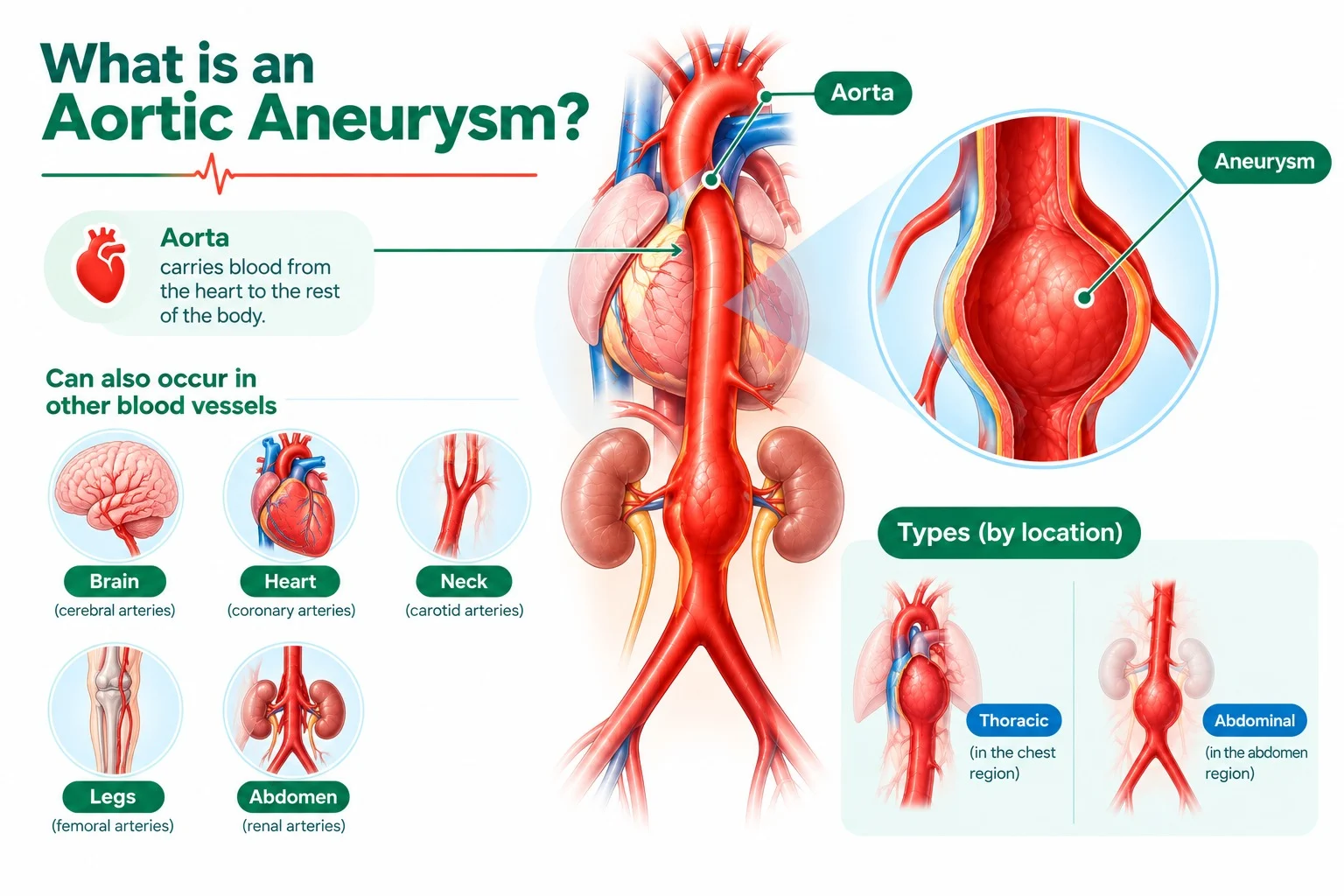
An aortic aneurysm is a weak, stretched area in the aorta. Aorta is the largest artery in the body, carrying blood from the heart to the rest of the body. As the wall weakens, the section gradually widens into a bulge.
Aneurysms are of two types: thoracic aortic aneurysm (TAA), in the chest, and abdominal aortic aneurysm (AAA), in the abdomen. They can also occur in arteries other than aorta.
A small aneurysm may stay stable for years, but a growing one weakens the artery further. If left unchecked it can rupture and cause severe internal bleeding, which is a medical emergency.
Aortic Aneurysms Symptoms
Most aortic aneurysms cause no noticeable symptoms and are found incidentally on imaging. When symptoms do develop, they include persistent pain, breathing or swallowing problems, or a pulsating sensation in the abdomen.
Signs and symptoms of TAA:
- Chest or upper back pain
- Shortness of breath
- Persistent cough
- Hoarseness
- Difficulty in swallowing
Symptoms of AAA:
- Deep abdominal pain
- Back or side pain
- Pulsating feeling near the navel
- Pain radiating to the legs or buttocks
Aortic Aneurysm Risk Factors
Age past 65, smoking, and high blood pressure are the three biggest drivers of aortic aneurysm risk. Some of the the risk factors of aortic aneurysm are:
- Age
- Smoking
- Family history
- High blood pressure
- Atherosclerosis
- Sex
- Connective tissue disorders
- Bicuspid aortic valve
Knowing these risk factors matters as it tells you when a screening ultrasound is worth doing.
Aortic Aneurysm Diagnosis
Diagnosis of aortic aneurysm is done through imaging because a physical exam alone often can’t confirm its size or exact location.
Ultrasound:
- Probe is moved gently over the chest/ abdomen
- Sound waves create a live image
- Painless, takes 15–20 minutes
- Usually the first test done, especially for AA
CT angiography
- Contrast dye injected into a vein; scanner captures cross-sectional images as it passes through the aorta
- Gives a detailed 3D view of size, shape, and location
- Takes 10–15 minutes
Catheter-based angiography
- Thin catheter guided through an artery, usually from the groin, up to the aorta
- Contrast dye released at the site
- More invasive than CT angiography
MRI
- Uses magnetic fields to build detailed images
- Preferred for repeated imaging over years, since there’s no cumulative radiation risk
Echocardiogram
- Sound waves create a real-time video of the heart and aorta
- Checks if aortic valve or heart function are affected
- Relevant for TAA
TEE (transesophageal echocardiography)
- Thin probe passed down the food pipe
- Gives closer, clearer view than ECG
- Useful for TAA
A lot of times, aneurysms are detected by-chance during scans for other conditions.
When Does an Aortic Aneurysm Need Repair?
An aortic aneurysm may need repair when the risk of rupture or other complications becomes significant. Doctors advise repair if:
- Size: Abdominal aneurysm crosses 5.5 cm in men (5.0 cm in women), or a thoracic aneurysm crosses 5.5 cm
- Growth rate: 0.5 cm or more in six months for abdominal aneurysms, or 0.5 cm or more in a year for thoracic
- Symptoms: Pain, organ pressure, or breathing/swallowing difficulty
- Location and shape: Some locations and shape pose high risk
- Rupture or leakage: Medical emergency
- Overall health: If body can handle the surgery
Smaller, stable, symptom-free aneurysms are usually just monitored with scans every 6–12 months rather than treated right away.
Aortic Aneurysm Treatment in Delhi
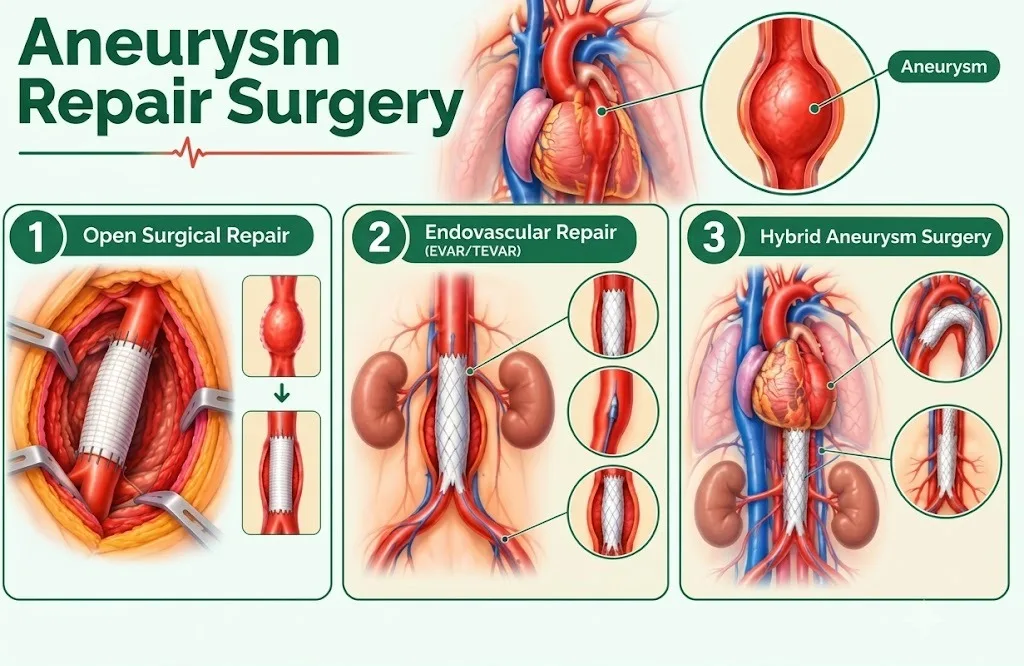
Treatment of aortic aneurysm includes aortic aneurysm surgery. It aims to fixe the aneurysm before it tears or ruptures, done either by open surgery or endovascular repair. In both cases, the goal is the same: reinforce the weak part so it can safely handle blood flow again.
Open surgical repair:
- A large incision in the abdomen/ chest
- The surgeon removes the aneurysm and replaces it with a synthetic graft
- Includes procedures like the Bentall procedure and valve-sparing aortic root replacement
Endovascular repair (EVAR/TEVAR)
- A minimally invasive procedure
- A stent graft (a fabric-covered metal tube) is guided through an artery in the groin and placed inside the aorta
- Reinforces the weak section of aorta from within
- Recovery is quicker, but needs regular imaging afterward to confirm the graft stays in place
Hybrid Aneurysm Surgery
- Combines open and endovascular techniques
- Used for complex or thoracoabdominal aneurysms
Most repairs take 2 to 6 hours, depending on whether it’s open surgery or EVAR. The right approach depends on the aneurysm’s location, shape, and the patient’s fitness for surgery.
How Is Open Aortic Aneurysm Repair Different from Endovascular Repair (EVAR)?
Open surgery is more durable long-term but has a longer recovery, while EVAR is less invasive with a quicker recovery but needs lifelong monitoring. Here is a table comparing both:
| Open Surgery | EVAR | |
| Approach | Chest or abdomen opened; weak section replaced with a graft | Stent graft placed via a small groin incision |
| Recovery time | Longer | Shorter |
| Long-term durability | High | Needs regular imaging; risk of endoleak or graft migration |
| Follow-up needed | Standard | Lifelong |
The right choice of treatment depends on the aneurysm’s anatomy and overall fitness for surgery.
Aortic Aneurysm Surgery Recovery Time
Recovery time ranges from 1 to 2 weeks for EVAR to 6 to 8 weeks for open surgery. Here is a table comparing the both.
| Open Surgery | EVAR | |
| Hospital stay | About a week | 2-3 days |
| Return to normal activity | 6-8 weeks | 1-2 weeks |
| Full internal healing | A few months | A few months |
The less invasive the procedure, the faster you’re back on your feet, but both need patience. How fast the recovery stays on track often comes down to the everyday habits covered next.
Aortic Aneurysm Surgery Recovery Tips
The right habits after aneurysm repair directly affect how well the graft heals and how soon you return to normal life. A few recovery tips:
- Avoid heavy lifting for 4–6 weeks
- Walk daily, starting short and slow
- Control BP
- Quit smoking (Smoking hinders healing)
- Follow-up regularly
- Watch for fever, redness at the incision site, or sudden pain
Sticking to these habits often separates a smooth recovery from a complicated one.
What Is the Cost of Aneurysm Repair Surgery in Delhi?
The cost of aortic aneurysm repair surgery in Delhi typically ranges between INR 3,00,000 to INR 5,00,000, which is a fraction of what it costs in Western countries. Several factors affecting the cost are:
- Length of hospital stay
- Type of hospital and room
- Type of aneurysm repair
- Patient’s overall health
A precise estimate can be given by your surgeon after reviewing your scans and overall health.
Why Choose Dr. Dinesh Kumar Mittal for Aneurysm Repair Surgery in Delhi?
The outcome of aneurysm repair depends heavily on the surgeon’s ability to handle both types of repairs and choose the right one for each patient. Dr. Dinesh Kumar Mittal, Senior Director and Head of Cardiothoracic and Vascular Surgery at Fortis Hospital, brings:
- 25+ years of experience in cardiothoracic and vascular surgery, across adult, paediatric, and neonatal cases
- Trained at AIIMS, New Delhi (M.Ch in CTVS), with an international fellowship in endovascular stenting from Milan, Italy
- Expertise in complex aortic procedures (Bentall procedure, thoracoabdominal aneurysm repair)
- Experience across both open and endovascular repair
Book a Consultation
An aortic aneurysm often causes no symptoms until it’s found on a scan, or until it grows large enough to need repair. Whether you’ve just received a diagnosis or want a second opinion, a specialist consultation is a crucial next step.
During your consultation with Dr. Dinesh Kumar Mittal, you will receive:
- A detailed review of your symptoms, medical history, and risk factors
- Evaluation of your imaging reports
- Assessment of the aneurysm and whether repair is needed now or can be monitored
- A clear comparison of which surgery is most appropriate for your case
If you already have a CT angiogram or other reports, bringing them to your first appointment allows for a more accurate evaluation.
Frequently Asked Questions
How risky is aortic aneurysm repair surgery? expand_more
It carries some risk, like any major surgery, but is far safer than leaving a growing aneurysm untreated. Planned repairs carry much lower risk than emergency ones.
Can you live many years after aortic aneurysm surgery? expand_more
Yes. With successful repair and regular follow-up, most people go on to live a normal lifespan.
What Does a Ruptured Aortic Aneurysm Feel Like? expand_more
A ruptured aortic aneurysm causes sudden, severe pain in the chest, back, or abdomen, along with dizziness, fainting, sweating, or a rapid heartbeat. This is a medical emergency needing care immediately.
Who is the best doctor for aneurysm repair surgery in Delhi? expand_more
Dr. Dinesh Kumar Mittal, Senior Director and Head of CTVS at Fortis Hospital, is one of the leading aneurysm repair surgeons with 25+ years of experience across both kinds of surgeries.
How do I book a consultation for aneurysm repair with Dr. Dinesh Kumar Mittal? expand_more
You can book a consultation directly through this page or by contacting Fortis Hospital, Shalimar Bagh. Bringing along any existing scans or angiography reports helps make the first appointment more accurate and useful.

Dr. Dinesh Kumar Mittal's Content Team
Dr. Dinesh Kumar Mittal's medical content team specialises in creating accurate, clear, and patient-focused healthcare content. With strong clinical understanding and expertise in technical writing and SEO, the team translates complex medical information into reliable, accessible resources that support informed decisions and uphold Dr. Mittal's commitment to quality care.
This content is reviewed by Dr. Dinesh Kumar Mittal
Related Treatments

Minimally Invasive Cardiac Surgery in Delhi
Minimally invasive cardiac surgery (MICS) is heart surgery performed through small incisions between the ribs, without splitting the full breastbone. It…
Bentall Procedure in Delhi
Serious problems of the aorta and aortic valve can be life-threatening if not treated in time. The Bentall Procedure is a specialised,…
 WhatsApp