
Exercise Dos and Don’ts for People With Heart Disease
If you have been diagnosed with heart disease, one of the first questions you are likely to ask is whether it is still safe to exercise. It is a fair worry, since movement raises your heart rate, and a heart already under strain can make that feel risky.
The truth is more reassuring. For most people with heart disease, the right kind of exercise is not something to fear; it is part of the treatment. Structured, supervised activity strengthens the heart muscle, improves circulation, and lowers the risk of a future cardiac event. The key is knowing which exercises are safe, how much is appropriate, and which warning signs mean you should stop.
Dr. Dinesh Kumar Mittal, Senior Cardiac and CTVS Surgeon at Fortis Hospital, Shalimar Bagh, Delhi, explains what a heart-safe exercise routine should look like, and where patients most often go wrong.
Request a Consultation
Is It Safe to Exercise With Heart Disease?
Yes, exercise is generally safe and beneficial for most patients with heart disease, provided it is tailored to your condition and cleared by your cardiologist.
Regular, moderate activity:
- Strengthens the heart muscle
- Improves blood vessel function
- Helps control the risk factors (high blood pressure, cholesterol, and blood sugar that drive further disease)
Avoiding exercise out of fear often does more harm than good, since deconditioning and reduced stamina place additional strain on the heart over time.
That said, intensity should always be matched to your diagnosis, whether that is coronary artery disease, a previous heart attack, heart failure, or a recent angioplasty or bypass surgery. A cardiac assessment, sometimes with a stress test, helps determine a safe starting point.
How Much Exercise Do Heart Patients Need?
Most stable heart patients are advised to aim for at least 150 minutes of moderate-intensity aerobic activity per week, spread across several sessions, alongside light muscle-strengthening exercises twice a week.
This target, drawn from international cardiac rehabilitation guidelines, works out to roughly 20 to 30 minutes on most days. It does not need to be completed in one block; three brisk 10-minute walks through the day offer similar heart benefits to one continuous session, which makes the goal more achievable in the early stages of recovery.
The important principle is consistency over intensity. A slow, steady increase over several weeks is safer than pushing hard on a single good day.
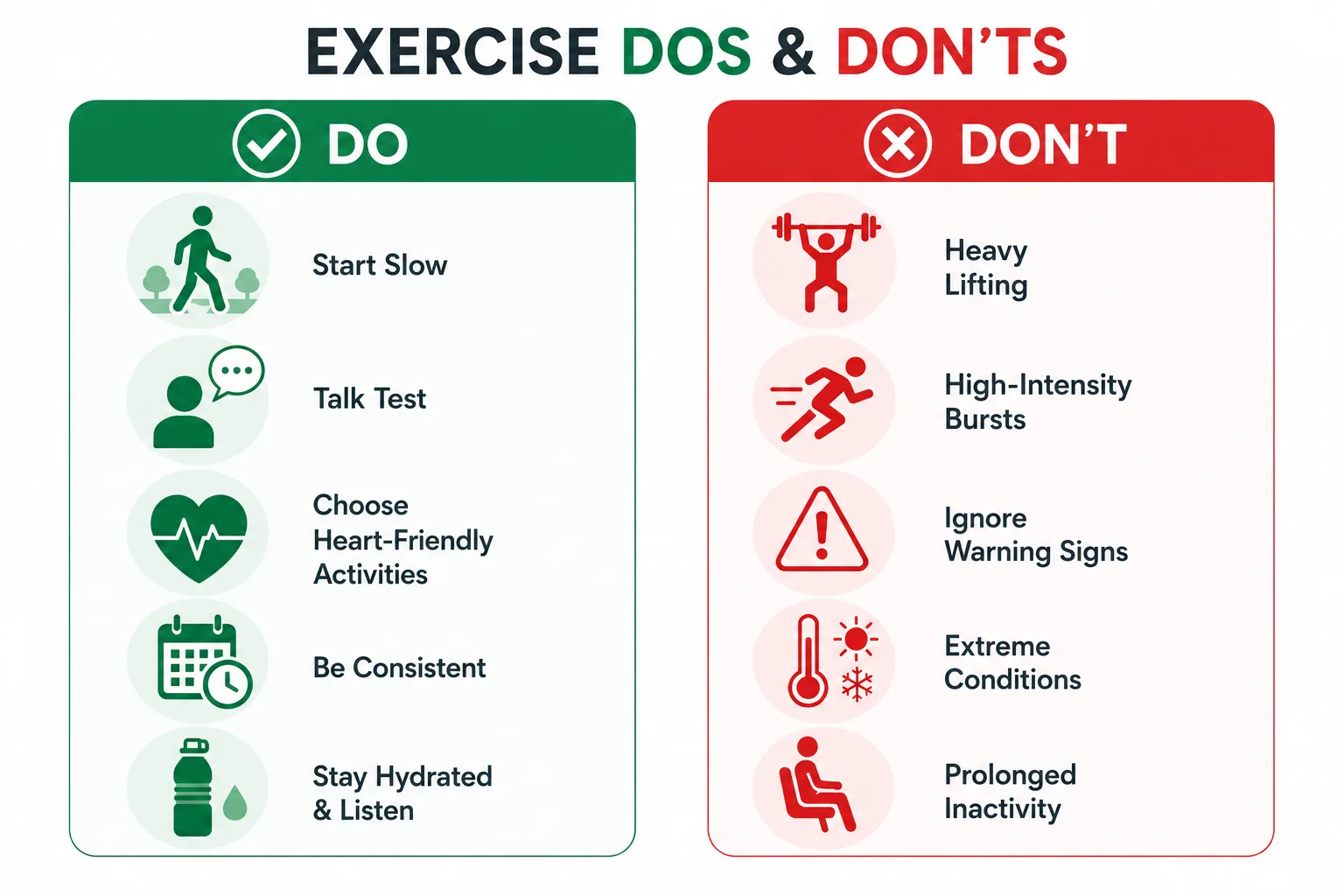
Exercise Dos for Heart Disease Patients
Certain habits make physical activity safer and more effective for a recovering or vulnerable heart.
- Do start with a cardiac rehabilitation programme: A supervised programme after a heart attack, angioplasty, or surgery monitors your heart rate and symptoms while you build tolerance safely.
- Do warm up and cool down: Five to ten minutes of gentle movement before and after exercise lets your heart rate rise and fall gradually.
- Do choose steady, rhythmic activity: Brisk walking, cycling on level ground, swimming, and light gardening are well tolerated and improve stamina without sudden spikes in demand.
- Do use the “talk test”: You should be able to hold a conversation during exercise; if you’re too breathless to speak in short sentences, the intensity is too high.
- Do stay consistent with medication and hydration: Take prescribed medications as directed, and drink water before and after activity, particularly in Delhi’s warmer months.
- Do track your progress: A simple log of duration and how you felt helps your cardiologist adjust your plan at follow-up visits.
Exercise Don’ts for Heart Disease Patients
Certain patterns of activity place unnecessary strain on a compromised heart and should generally be avoided.
- Don’t exercise without medical clearance after a cardiac event: Following a heart attack, stent placement, or open-heart surgery, wait for your surgeon’s or cardiologist’s sign-off before resuming structured exercise.
- Don’t lift heavy weights or strain suddenly: Heavy weightlifting, moving furniture, or intense sit-ups can cause a sharp, temporary spike in blood pressure that can be risky for a weakened heart.
- Don’t exercise in extreme heat, cold, or right after a large meal: Both make the heart work harder to manage blood flow, adding avoidable stress.
- Don’t ignore warning symptoms: Chest discomfort, unusual breathlessness, dizziness, cold sweats, or irregular heartbeat are signals to stop immediately, not signs to push through.
- Don’t jump straight into vigorous activity: Sudden bursts of high-intensity exercise without a gradual build-up are a common trigger for cardiac events in people with underlying coronary artery disease.
- Don’t skip rest days: The heart needs recovery time between sessions, particularly in the weeks following a procedure.
What Are the Warning Signs to Stop Exercising Immediately?
Stop exercising at once and seek medical help if you experience chest pain or pressure, unusual shortness of breath, dizziness, cold sweating, a racing or irregular heartbeat, or sudden fatigue that feels different from normal tiredness.
These symptoms may indicate the heart is not receiving adequate blood flow during activity.
Dr. Mittal notes, “Patients are often reluctant to stop mid-exercise because they don’t want to feel like they are giving up, but recognising these signs early is exactly what protects long-term heart health. There is no benefit in pushing through a warning sign.”
If symptoms resolve with rest, contact your cardiologist before resuming exercise. If they persist, seek emergency care.
Best Exercises for Different Heart Conditions
The right activity depends on the specific diagnosis and treatment history.
- After a heart attack or angioplasty: Supervised walking programmes, progressing gradually in pace and distance, form the foundation of early cardiac rehabilitation.
- After CABG or open-heart surgery: Light walking begins within days, with rehabilitation building tolerance over 6 to 12 weeks; heavy lifting is avoided until the breastbone has healed.
- With peripheral artery disease: Supervised interval walking, alternating activity with rest, is proven to improve walking distance; see our PAD treatment page for more.
- With heart failure or cardiomyopathy: Exercise is still recommended but gentler and closely monitored; read more on our cardiomyopathy page.
- With atrial fibrillation: Moderate aerobic activity is encouraged, but competitive or extreme endurance exercise should be discussed with your cardiologist first.
Why a Personalised Exercise Plan Matters
Every heart patient has different medical needs, even when they share the same diagnosis. Your age, heart function, blood pressure, medications, previous heart attack, angioplasty, bypass surgery, or valve surgery all influence how much physical activity is safe. Following a generic workout plan can increase the risk of chest pain, abnormal heart rhythms, excessive fatigue, or delayed recovery.
A personalised exercise plan is designed around your current cardiovascular health, ensuring that the type, intensity, duration, and progression of exercise match your individual condition. This approach helps you rebuild stamina safely while reducing the risk of complications and supporting long-term heart health.
Conclusion
Before recommending an exercise programme, your cardiologist or cardiac rehabilitation team performs a detailed assessment of your cardiovascular health. This may include a clinical examination, ECG, echocardiogram, blood pressure evaluation, and, when appropriate, an exercise stress test (TMT) to understand how your heart responds to physical activity.
Based on these findings, a structured cardiac rehabilitation plan is created with safe heart rate targets, suitable aerobic activities, strength training recommendations, and a gradual progression schedule.
As your recovery improves, the plan is regularly reviewed and adjusted. Under the supervision of an experienced cardiac surgeon like Dr. Dinesh Kumar Mittal, this personalised approach helps patients regain confidence, improve cardiovascular fitness, and return to daily activities as safely as possible.

 WhatsApp