
Peripheral Artery Disease Treatment in Delhi
Peripheral artery disease (PAD) is a circulatory condition in which plaque builds up inside the arteries supplying the legs, progressively narrowing them and reducing blood flow. Peripheral Artery Disease is one of the most underdiagnosed vascular conditions in India, affecting millions of adults, particularly those with diabetes, high blood pressure, or a history of smoking.
PAD treatment in Delhi, when guided by an experienced peripheral artery disease specialist, can halt disease progression, relieve symptoms, and in many cases restore near-normal circulation, without open surgery.
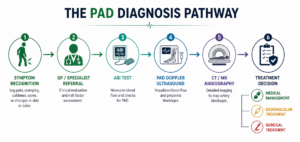
Dr. Dinesh Kumar Mittal, Director and Head of Cardiothoracic and Vascular Surgery at Fortis Hospital, Shalimar Bagh, provides comprehensive peripheral artery disease treatment and peripheral vascular disease treatment for patients across Delhi and NCR, combining advanced PAD diagnosis with both medical and interventional approaches tailored to each patient’s condition.
Request a Consultation
What Is PAD?
Peripheral artery disease is a condition where the arteries outside the heart and brain, most often those supplying the legs, become narrowed due to atherosclerosis. In PAD, atherosclerosis causes fatty deposits (plaque) to build up on the inner walls of the peripheral arteries, gradually restricting blood flow.
PAD is sometimes also referred to as peripheral vascular disease (PVD), though the two terms are slightly different. Peripheral vascular disease treatment encompasses a broader range of arterial and venous conditions, whilst PAD specifically refers to atherosclerotic narrowing of the arteries.
How PAD develops:
- Plaque (cholesterol, calcium, and fibrous tissue) accumulates inside artery walls, a process known as PAD atherosclerosis
- The artery narrows progressively, reducing blood flow to the muscles and tissues of the limb
- During physical activity, muscles demand more oxygen, but the narrowed artery cannot deliver enough, resulting in pain or cramping
- In severe PAD, even resting blood flow becomes inadequate, causing pain at rest, skin changes, and ulceration
Peripheral Artery Disease Symptoms: How to Recognise PAD Early?
Peripheral artery disease symptoms are frequently dismissed as tiredness, age-related aches, or “poor circulation.” This delay in recognition is one reason PAD is so often diagnosed late. Knowing what to look for can make the difference between early, manageable PAD treatment and a limb-threatening emergency.
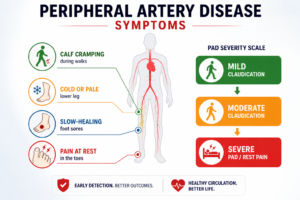
A patient presenting with peripheral artery disease symptoms should also be evaluated for coronary artery disease, as both conditions frequently coexist.
Do not wait if you notice these signs. A PAD specialist can assess your risk and initiate a peripheral artery disease diagnosis before the condition worsens.
When Should You See a PAD Specialist in Delhi?
A peripheral artery disease specialist, or peripheral vascular disease treatment expert, should be consulted promptly if you:
- Experience leg cramps or fatigue during walks that ease with rest
- Have been told by a doctor that you have a blocked artery in the leg
- Have diabetes and notice foot numbness, ulcers, or slow-healing wounds
- Smoke or have smoked for many years, alongside other cardiovascular risk factors
- Are over 60 and have high blood pressure, high cholesterol, or a family history of arterial disease
- Have already had a heart attack, stroke, or carotid artery disease
- Have been diagnosed with deep vein thrombosis (DVT) and need a full vascular assessment
Early referral to a peripheral artery disease specialist significantly improves the likelihood of managing the condition without major intervention.
PAD Diagnosis: How Is Peripheral Artery Disease Detected?
Accurate peripheral artery disease diagnosis is the essential first step before any peripheral artery disease treatment can begin. Peripheral artery disease diagnosis combines clinical examination with specialised imaging and functional tests, each providing different information about the location, severity, and extent of arterial narrowing.
| Peripheral Artery Disease Test | What It Measures | When It Is Used |
|---|---|---|
| Ankle-Brachial Index (ABI) | Compares blood pressure at the ankle vs the arm. A ratio below 0.9 confirms PAD | First-line PAD test, quick, painless, and non-invasive |
| PAD Doppler (Duplex Ultrasound) | Visualises blood flow and maps blockage location and severity | Standard in peripheral artery disease diagnosis; no radiation |
| CT Angiography | Detailed cross-sectional imaging of the artery anatomy | Used when a precise PAD diagnosis is needed before intervention |
| MR Angiography | Magnetic resonance imaging of peripheral arteries | Alternative to CT; avoids radiation exposure |
| Digital Subtraction Angiography (DSA) | Gold-standard real-time artery imaging via catheter | Used for complex PAD diagnosis immediately before stenting or bypass |
| Exercise Treadmill ABI Test | Measures ABI changes after walking | Confirms PAD in patients with mild or atypical symptoms |
| Blood Tests | Cholesterol, blood sugar, and inflammatory markers | Part of a full cardiovascular risk assessment alongside PAD diagnosis |
PAD diagnosis often reveals cardiovascular disease beyond the legs. A PAD Doppler result showing significant narrowing may prompt further evaluation of the coronary arteries or aorta, because PAD atherosclerosis is rarely limited to one territory.
Peripheral Artery Disease Treatment Options in Delhi
Peripheral artery disease treatment is matched to the severity of PAD, the patient’s overall cardiovascular health, and the anatomy of the blockage. Treatment ranges from lifestyle modification and medication through to catheter-based procedures and surgery.
1. Medical Management and Lifestyle Changes
For patients with mild to moderate PAD, medical treatment combined with supervised exercise forms the foundation. These measures slow PAD atherosclerosis, reduce symptoms, and lower the risk of heart attack and stroke.
- Stopping smoking: The single most impactful step in all stages of PAD treatment
- Supervised walking exercise: 30-45 minutes, at least five times per week, has been shown to improve claudication distance significantly
- Antiplatelet therapy: Aspirin or clopidogrel to reduce the risk of arterial clotting
- Peripheral artery disease vasodilator therapy: Cilostazol, a peripheral artery disease vasodilator, is used in selected patients to improve blood flow and reduce claudication symptoms
- Statins: To stabilise PAD atherosclerosis, lower cholesterol, and reduce cardiovascular risk
- Blood pressure and blood sugar control: Essential to slow arterial disease progression, particularly in diabetic patients
2. Endovascular (Catheter-Based) PAD Treatment
When medical management does not adequately control symptoms, or when PAD diagnosis reveals significant blockages in major arteries, catheter-based procedures offer effective, minimally invasive pad treatment without open surgery.
- Balloon Angioplasty: A thin catheter with a small balloon is guided to the narrowed artery and inflated to widen it, restoring blood flow
- Peripheral Artery Stenting: A metal mesh tube (stent) is placed inside the artery after balloon dilation to keep it open
- Atherectomy: A catheter-based device removes or shaves plaque from the artery wall, particularly useful in calcified PAD atherosclerosis
- Drug-Coated Balloon Therapy: A balloon coated with a medication is used to reduce the risk of re-narrowing after dilation
These procedures are performed under local anaesthesia with a hospital stay of one to two days.
3. Surgical PAD Treatment
For severe PAD with long, complex, or multi-segment blockages not suitable for catheter-based pad treatment, surgery offers a durable solution.
- Peripheral Bypass Surgery: A healthy blood vessel or synthetic graft is used to route blood around the blocked artery, the same principle applied in CABG surgery for the heart
- Endarterectomy: Surgical removal of plaque directly from the artery wall
- Amputation: Only considered in the most advanced, non-salvageable cases of severe PAD, where tissue death is irreversible
Severe PAD: Why Delayed Treatment Carries Serious Consequences?
Severe PAD, clinically known as Critical Limb-Threatening Ischaemia (CLTI), represents end-stage peripheral artery disease where blood supply to the limb has critically reduced. Severe PAD is defined by the presence of one or more of the following:
- Constant rest pain in the foot or toes, often worse at night
- Non-healing ulcers or wounds on the feet or lower legs
- Gangrene in the toes, foot, or lower leg
Without prompt peripheral artery disease treatment, severe PAD carries an amputation risk of up to 25% within one year. Severe PAD also significantly elevates the risk of heart attack and stroke, because the PAD atherosclerosis, causing the limb blockage, is almost never confined to one artery alone.
Patients with severe PAD need urgent evaluation by a peripheral artery disease specialist. The window for limb-saving intervention is time-sensitive.
Peripheral Artery Disease Treatment Cost in Delhi
PAD treatment cost in Delhi typically ranges from ₹80000 to ₹ 4,50,000, depending on whether the condition requires medical management, an endovascular procedure, or surgery. The table below gives an indicative range.
| PAD Treatment Type | Estimated Cost |
|---|---|
| PAD Diagnosis (Doppler + ABI + Blood Tests) | ₹3,000 – ₹8,000 |
| CT Angiography (Peripheral) | ₹8,000 – ₹15,000 |
| Balloon Angioplasty ± Peripheral Stenting | ₹80,000 – ₹1,80,000 |
| Atherectomy / Drug-Coated Balloon | ₹1,20,000 – ₹2,50,000 |
| Peripheral Bypass Surgery | ₹1,50,000 – ₹4,50,000 |
The final cost is confirmed at the consultation based on the PAD diagnosis findings, the number of arteries involved, and the treatment approach selected. Most health insurance policies in India cover interventional PAD treatment under inpatient hospitalisation benefits. Cashless treatment may be available at Fortis Hospital, Shalimar Bagh for eligible policyholders.
Not sure what your PAD treatment will cost? Book a consultation with Dr. Dinesh Kumar Mittal and receive a personalised written cost estimate based on your PAD diagnosis and treatment needs.
Peripheral Artery Disease Treatment Cost For International Patients
PAD treatment in Delhi costs a fraction of what the same procedures cost in the UK, the USA, or the GCC, with no compromise on surgical expertise or hospital accreditation.
| Currency | Balloon Angioplasty/ Stenting | Peripheral Bypass Surgery |
|---|---|---|
| USD | USD 950 – 2,200 | USD 1,800 – 4,200 |
| GBP | GBP 750 – 1,750 | GBP 1,400 – 3,300 |
| AED | AED 3,500 – 8,000 | AED 6,600 – 15,400 |
Currency conversions are indicative and subject to change. International patients can share PAD Doppler or CT angiography reports with Dr. Dinesh Kumar Mittal for a remote pre-travel assessment and a confirmed cost estimate before making travel arrangements.
Why Patients Choose Dr. Dinesh Kumar Mittal as Their PAD Specialist in Delhi
Choosing the best cardiovascular specialist in Delhi determines not just the procedure performed but also whether the underlying arterial disease is fully understood and managed comprehensively over the long term.
Dr. Dinesh Kumar Mittal brings 25+ years of cardiothoracic and vascular surgical experience to every PAD consultation, with specific training in endovascular interventions and a consistent focus on evidence-based peripheral vascular disease treatment.
Patients across Delhi and NCR trust Dr. Mittal because of:
- 25+ years of cardiothoracic and vascular surgical expertise
- Fellowship in Endovascular Stenting, Milan, Italy, directly relevant to catheter-based PAD treatment and peripheral artery stenting
- MCh (AIIMS, New Delhi), India’s highest post-graduate qualification in cardiothoracic surgery
- Advanced diagnostic infrastructure at Fortis Hospital, Shalimar Bagh, PAD Doppler, CT angiography, and a fully equipped catheterisation laboratory for complete peripheral artery disease diagnosis and treatment under one roof
His approach goes beyond treating a single blocked artery. Every patient with PAD receives a full assessment of cardiovascular risk, a structured PAD diagnosis, and a personalised pad treatment plan designed to protect both limb and heart health over the long term.
Book a Consultation for Peripheral Artery Disease Treatment in Delhi
PAD develops silently over the years. Many patients have significant arterial narrowing before their first symptom appears. By the time claudication becomes limiting, or a foot wound fails to heal, the window for straightforward peripheral artery disease treatment may already be narrowing.
Early consultation with a peripheral artery disease specialist ensures timely PAD diagnosis, appropriate risk stratification, and a treatment plan matched to your specific condition, before severe PAD develops.
During your consultation, Dr. Dinesh Kumar Mittal will provide:
- Full clinical vascular examination and symptom review
- Interpretation of any existing PAD Doppler, ABI, or CT angiography reports
- Assessment of PAD severity, disease extent, and cardiovascular risk
- Clear explanation of all peripheral artery disease treatment options, including medical, endovascular, or surgical
- Personalised peripheral vascular disease treatment plan based on your anatomy, health status, and daily life needs
- Transparent discussion of expected recovery, follow-up requirements, and cost
If leg pain, foot wounds, or an abnormal vascular report has been flagged by your GP or another doctor, the next step is to seek a specialist opinion before symptoms progress.
Frequently Asked Questions
What is the difference between PAD and peripheral vascular disease? expand_more
PAD specifically refers to atherosclerotic narrowing of peripheral arteries. Peripheral vascular disease is a broader term covering all blood vessel disorders outside the heart, including venous conditions.
What does a PAD Doppler test involve? expand_more
A PAD Doppler (duplex ultrasound) uses sound waves to visualise blood flow inside the peripheral arteries. It is painless, involves no radiation, and is one of the most important peripheral artery disease tests for confirming a PAD diagnosis.
Can severe PAD be treated without amputation? expand_more
In many cases, yes, provided treatment is sought promptly. Severe PAD causing rest pain or non-healing ulcers can often be managed with balloon angioplasty, peripheral stenting, or bypass surgery to restore blood flow and allow the tissue to heal.
Is peripheral artery disease treatment covered by insurance in India? expand_more
Most health insurance policies in India cover interventional treatment for peripheral artery disease, including angioplasty and bypass surgery, under inpatient hospitalisation benefits. Cashless facilities may be available at empanelled hospitals, including Fortis Shalimar Bagh.
How do I book a consultation with Dr. Dinesh Kumar Mittal? expand_more
You can book an appointment with Dr. Dinesh Kumar Mittal by contacting Fortis Hospital, Shalimar Bagh directly, or through the online appointment facility.

Dr. Dinesh Kumar Mittal's Content Team
Dr. Dinesh Kumar Mittal's medical content team specialises in creating accurate, clear, and patient-focused healthcare content. With strong clinical understanding and expertise in technical writing and SEO, the team translates complex medical information into reliable, accessible resources that support informed decisions and uphold Dr. Mittal's commitment to quality care.
This content is reviewed by Dr. Dinesh Kumar Mittal
Related Conditions

Heart Failure Treatment in Delhi
Heart failure does not mean the heart has stopped working; it means the heart is no longer pumping blood as…
Deep Vein Thrombosis (DVT) Treatment in Delhi
Deep Vein Thrombosis (DVT) is a medical condition in which a blood clot forms in the deep veins of the body,…
Pulmonary Embolism Treatment in Delhi
Pulmonary embolism treatment in Delhi must be swift, because pulmonary embolism (PE) is a medical emergency in which a blood…
Congestive Heart Failure Treatment in Delhi
Congestive heart failure (CHF) occurs when the heart loses its ability to pump blood effectively. As a result, fluid builds…
Coronary Artery Disease (CAD) Treatment in Delhi
Coronary Artery Disease (CAD) Treatment in Delhi plays a vital role in protecting heart health and preventing serious cardiovascular complications. CAD…
Related Blogs

Life After Heart Surgery: Recovery, Risks & What to Expect?
The surgery is done. The heart is beating. And now, sitting in a hospital ward…
Read Article →
CABG vs. Angioplasty: How Do You Know Which One You Actually Need?
If you or someone in your family has been told that the heart arteries are…
Read Article →
Understanding Heart Failure Surgery: What are the Procedures, Risks, and Costs Involved?
Heart failure surgery addresses critical heart issues through various procedures aiming to enhance heart…
Read Article →
How is Total Arterial CABG Beneficial for Cardiac Wellness and Longevity of a Patient’s Life? – Dr. Dinesh Mittal
Cardiac wellness is vital in giving heart patients more longevity and better overall health.…
Read Article →
What is the Difference Between On-Pump and Off-Pump CABG? – Dr. Dinesh Mittal
In the world of heart surgery, the choice between on-pump and off-pump coronary artery…
Read Article →
What Post-Operative Care is Needed After Open Heart Surgery?
Undergoing open heart surgery is a life-changing event for many patients. It’s one of…
Read Article → WhatsApp