
Varicose Veins Exercises: Best Movements to Improve Blood Flow

If you are also dismissing varicose veins as just a cosmetic issue, you might need to reconsider. Behind the blue bulge and thick veins, there’s a signal that blood is not returning to your heart properly. Ignoring this signal is where complications can start.
However, with early intervention and consistent care, the symptoms of varicose veins can be managed well. A big part of managing them involves keeping your body active. Walking, cycling, swimming and exercises involving gentle movements can provide more benefits to your vein health than you realise.
Request a Consultation
What are varicose veins?
Healthy veins are usually thin and run smoothly beneath the skin. In varicose veins, however, as the name says, the veins become thick and twisted and appear as a dark purple bulge beneath the skin.
Imagine a pipeline network that carries the clean water to all the houses in the society. The houses use water, and the waste water produced is collected by these pipes for cleaning.
A similar network of pipe-like structures called blood vessels is spread throughout our body. They are of two types:
- Arteries- They carry the oxygen-rich blood from heart to the organs.
- Veins- They carry carbon dioxide-rich blood from organs to heart for purification.
Healthy veins are usually thin and run smoothly beneath the skin. In varicose veins, however, as the name says, the veins become thick and twisted and appear as a dark purple bulge beneath the skin.
The twist of veins: How varicose veins develop?
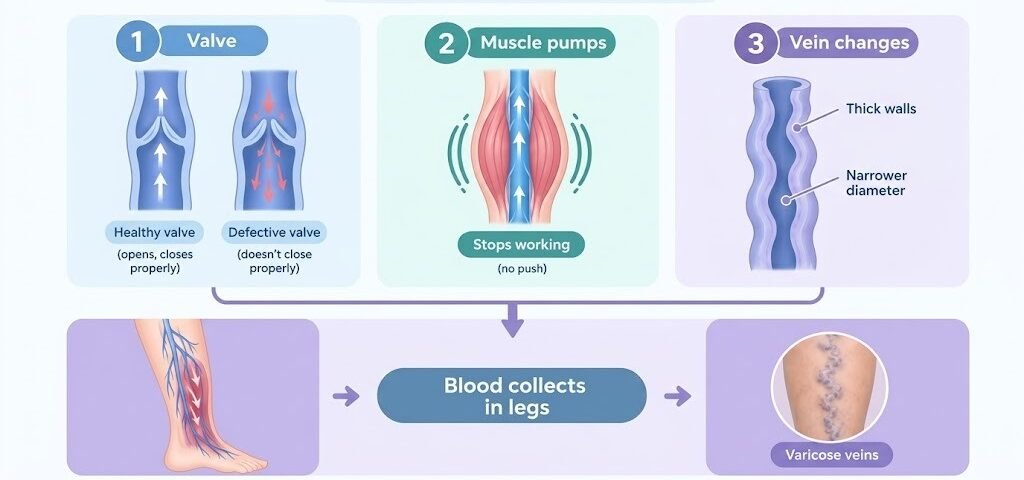
Varicose veins can develop at any part of the body, but legs are the most common site. Being present on the lower extreme of the body, the veins in legs have to constantly push the blood against gravity.
This flow is supported by:
- Muscle pumps: Present in the foot and calf, they power the blood flow from legs to heart.
- Valves: They act like a door that opens in one direction only. As blood pushes on these gates, they open up. The blood flows in and the gates close behind them, preventing any backflow into the legs.
Varicose veins can develop if any of these mechanisms fail:
Beyond the bulge: Varicose veins symptoms
The appearance of dark purple or blue bulge under the skin is typically the first visible sign of varicose veins.
Other early symptoms can include:
- Persistent discomfort and heaviness in the leg
- Leg cramps at night time
- Itching over the affected areas caused by dryness and inflammation
- Skin changes (discoloration, dry and scaly skin)
“A lot of people who come to me with varicose veins do not report experiencing pain initially,” says Dr. Dinesh Kumar Mittal, a senior vascular surgeon, “however, with the progression of disease, reports of swelling around ankles and a burning pain rise. These symptoms can worsen with long periods of inactivity. Treatment plans can definitely help, but they cannot replace the benefits of regular exercise.”
Best exercises for varicose veins
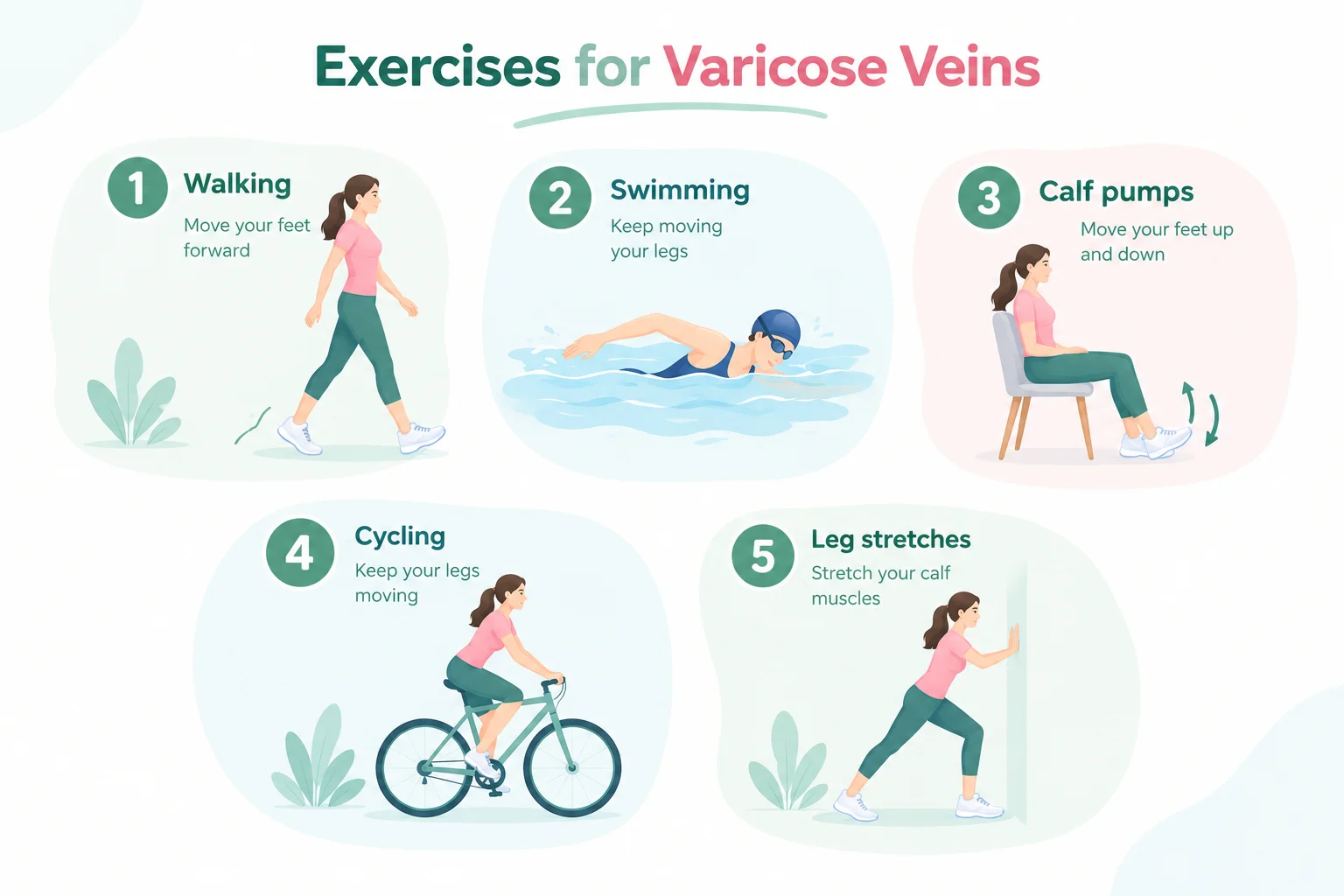
Walking, swimming, leg raises and gentle foot movements like ankle circles are some of the most recommended exercises for varicose veins.
No treatment plan can completely cure varicose veins. But regular activity can provide significant relief to the symptoms and improve the quality of life.
- Walking: It is the simplest, safest and one of the most effective movements to relieve the symptoms of varicose veins. Calf muscles are activated with each step, blood circulation is improved, and blood pooling is prevented. For better results, practice short sessions spread out across the day, rather than a single long session. A 5 minute walk every hour or two, is substantially more beneficial than an hour of continuous walk but an inactive rest of the day.
- Leg raises: Another recommended exercise, leg raises use gravity to help reduce blood pooling in the legs. To perform them, lie flat on your back with your hands beside you. Slowly lift your right leg and hold it for 5-7 seconds, then lower it gently. Repeat for 7–10 repetitions, followed by the same movement with your left leg.
- Swimming: An excellent low-impact exercise, swimming can help improve circulation and ease discomfort in the legs. The rhythmic kicking activates the calf muscles, while the water provides gentle pressure that supports blood flow. Its cooling effect may also soothe throbbing or aching legs. Because the body is supported by buoyancy and the legs are closer to heart level in a horizontal position, the effects of gravity are reduced, making it easier for blood to return towards the heart. Swimming can therefore be a good alternative for people who find compression stockings uncomfortable to wear.
- Cycling (Indoor and outdoor): The pedalling motion activates the calf muscles, improves circulation. Regular cycling helps maintain a healthy weight, reduces pressure on the limbs.
- Leg Stretches: 15-20 seconds of stretches (leg stretch, hamstring stretch, quad stretch) activates calf muscles. Improves circulation.
Varicose Vein Exercises for those with sedentary Jobs
“In my 25 years as a vascular surgeon, I’ve seen the number of younger patients with varicose veins rise significantly. Varicose veins don’t just affect the elderly anymore, and a big part of the answer lies in the sedentary lifestyles common in metropolitan cities like Delhi.” says Dr. Mittal
Prolonged sitting or standing can become unavoidable if they are a part of your job (For eg: Teachers, corporate workers). But taking care of your vein health is still possible. In fact, a lot of effective exercises can be performed in the workplace without attracting unwanted attention.
Foot pumps
- Sit in a comfortable position on a chair
- Using your ankle as a pivot, point your toes towards your body
- Then point them downwards, away from your body
- Do 6-10 repetitions
Ankle circles
- Sit on a chair with one leg on top of the other
- Move the foot of the leg on top in a clockwise and anti-clockwise directions
- Do 10-15 reps in each direction
- Repeat for the other foot.
These movements activate the calf muscle pump, helping push blood back toward the heart even while seated.
A study on NCBI reports that nearly 1 in 10 adults in India suffer from varicose veins, with the number rising to 1 in 2 among those over the age of 50.
Despite this, actual clinical cases remain underreported, largely because many people don’t seek medical help until complications arise.
“A lot of patients come to me when the condition has already progressed towards complications. This not only shrinks the available treatment options, but can be risky for patients too, often leaving us with surgery as the last resort.” Dr. Dinesh Kumar Mittal, Senior Director & HOD (Head of Department), Cardiothoracic and Vascular Surgery, Fortis hospital, Delhi.
Conclusion
Varicose veins are more than a cosmetic concern, but they’re also far from unmanageable. Simple movements like walking, swimming, and leg raises can meaningfully support your vein health when practiced consistently. Start with something as simple as a 5-minute walk, your veins will thank you for it.

 WhatsApp