
LVAD Implantation in Delhi
When the heart’s left ventricle becomes too weak to pump blood effectively on its own, a Left Ventricular Assist Device (LVAD) offers a life-sustaining solution. An LVAD implant is a surgically placed mechanical pump that takes over or supports the heart’s pumping function, restoring circulation and significantly improving quality of life for patients with end-stage heart failure.
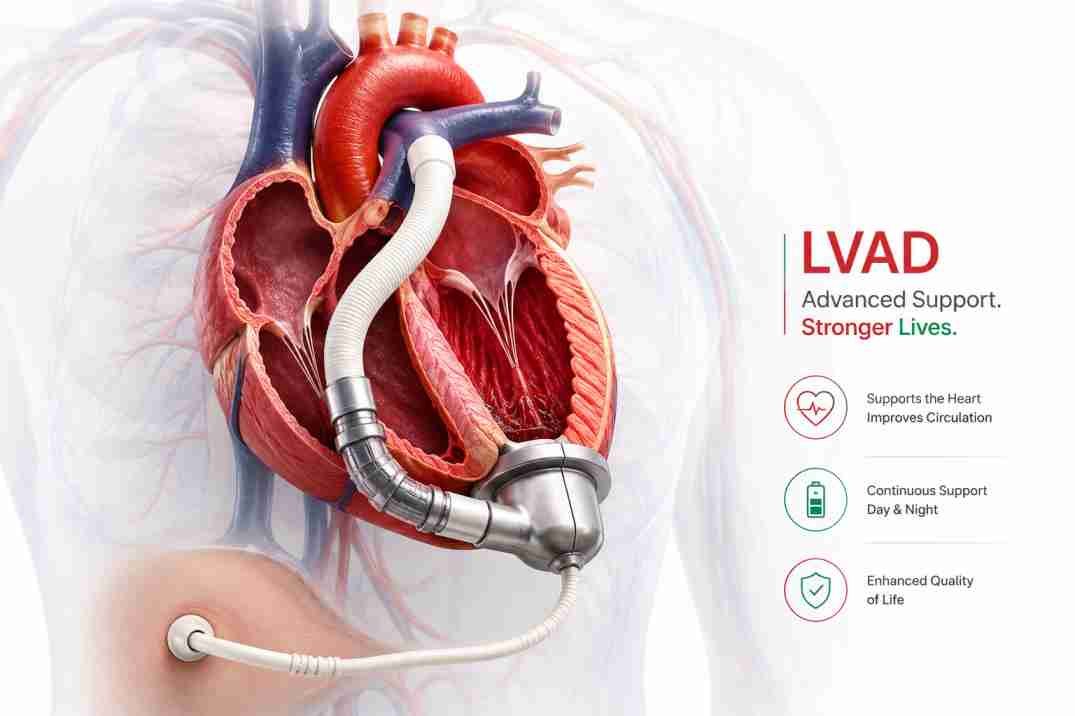
For patients who have exhausted medical therapy, or who are awaiting a heart transplant, LVAD implant surgery can mean the difference between deterioration and a return to meaningful daily activity.
Dr. Dinesh Kumar Mittal, Senior Cardiac and CTVS Surgeon at Fortis Hospital, Shalimar Bagh, Delhi, brings over 25 years of cardiothoracic and vascular surgical experience to the management of advanced heart failure. His expertise spans both surgical implantation and comprehensive long-term device management, ensuring patients receive specialist-guided care at every stage.
Request a Consultation
What Is an LVAD Implant?
An LVAD, or Left Ventricular Assist Device, is a battery-powered mechanical pump surgically implanted inside the chest. It is attached to the heart’s left ventricle and the aorta, continuously drawing blood from the weakened ventricle and propelling it into the body’s main artery, effectively doing the work the failing heart can no longer perform adequately.
Unlike an artificial heart, which replaces the heart entirely, an LVAD works alongside the existing heart, supporting rather than substituting it.
The device has two main components:
- Internal pump: Implanted inside the chest, connected to the heart and aorta
- External controller and batteries: Connected via a driveline that passes through the abdominal wall, powering and managing the pump
Modern continuous-flow LVADs, such as the HeartMate 3 (Abbott), use magnetic levitation technology to move blood with minimal mechanical wear, dramatically improving durability and reducing the risk of complications compared to earlier-generation devices. According to the STS INTERMACS Registry, in 2022, over 99% of LVAD implantations in the United States used fully magnetically levitated devices, a reflection of how decisively the technology has advanced.
What Is LVAD Implantation Used For?
LVAD implantation is a specialised intervention for patients with advanced or end-stage heart failure. It is used in three principal clinical scenarios:
- Bridge to Transplant (BTT): For patients awaiting a heart transplant, an LVAD sustains life and stabilises heart function until a suitable donor organ becomes available. Waiting periods in India can be prolonged; an LVAD provides critical support during this time.
- Destination Therapy (DT): For patients who are not eligible for a heart transplant, due to age, other health conditions, or patient preference, an LVAD serves as a permanent, long-term treatment.
- Bridge to Recovery: In select cases where the underlying cause of heart failure is potentially reversible, such as post-viral cardiomyopathy, an LVAD supports the heart whilst recovery is monitored, with removal considered if function improves sufficiently.
Who Needs LVAD Implant Surgery?
LVAD implant surgery is considered for patients with advanced heart failure who are not responding to optimal medical treatment. Typical indicators include:
- New York Heart Association (NYHA) Class III–IV symptoms despite maximum medical therapy
- Left ventricular ejection fraction (LVEF) of 25% or less
- Frequent hospitalisations for decompensated heart failure
- Dependence on intravenous inotropic medications to maintain circulation
- Cardiogenic shock or haemodynamic instability
- Awaiting cardiac transplantation with a prolonged expected wait
Conditions that commonly lead to this stage include ischaemic cardiomyopathy, dilated cardiomyopathy, and advanced coronary artery disease with severely impaired left ventricular function.
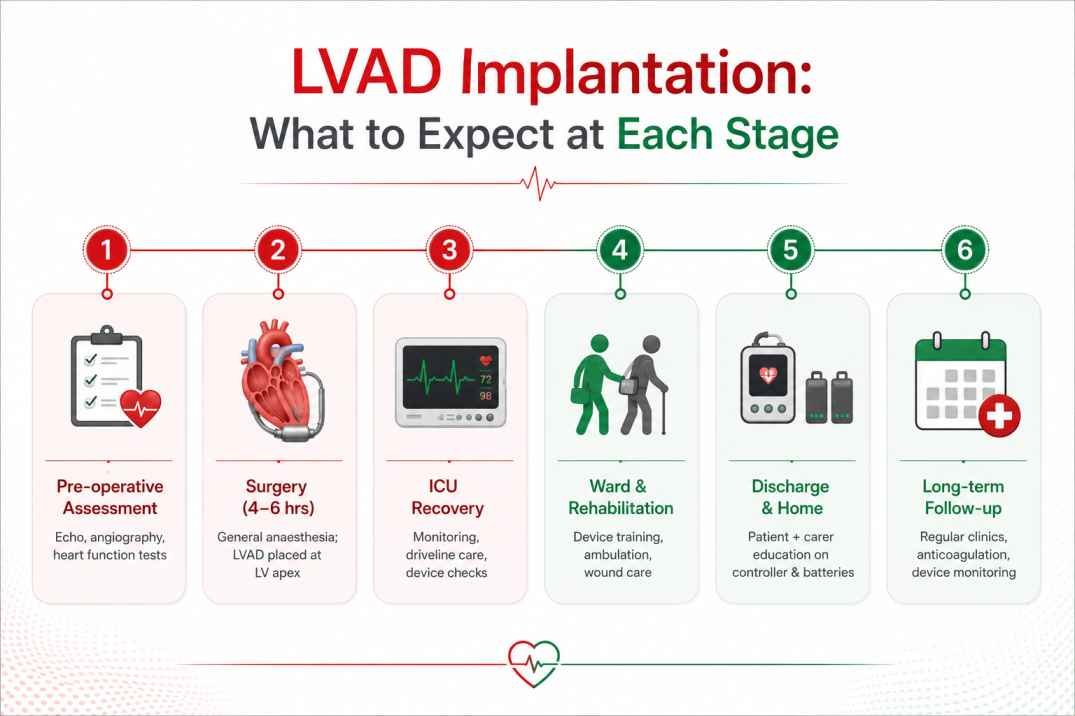
How Is LVAD Implantation Performed?
The LVAD implantation procedure is carried out in a specialised cardiac surgery theatre under general anaesthesia, typically using cardiopulmonary bypass to safely operate on the heart.
Step 1: Pre-operative Evaluation
A thorough assessment is conducted before surgery, including echocardiography, coronary angiography, CT scans of the chest and abdomen, lung function tests, kidney and liver function tests, and a nutritional and psychological evaluation. This helps determine suitability, device sizing, and surgical planning.
Step 2: Anaesthesia and Surgical Access
General anaesthesia is administered. The chest is opened via a median sternotomy (incision along the breastbone), and the patient is placed on cardiopulmonary bypass to allow safe cardiac manipulation.
Step 3: Device Placement
The pump is secured to the apex (base) of the left ventricle, and an outflow graft is attached to the ascending aorta. The pump continuously draws blood from the ventricle and delivers it to the aorta, bypassing the weakened chamber.
Step 4: Driveline Tunnelling
The driveline, a cable connecting the internal pump to the external controller and battery system, is passed through a small exit site on the abdominal wall. Meticulous driveline care post-operatively is critical to reducing infection risk.
Step 5: Weaning from Bypass and Closure
Once the device is confirmed to be functioning correctly, the patient is weaned off cardiopulmonary bypass, the chest is closed, and the patient is transferred to the cardiac ICU.
Recovery After LVAD Implant Surgery
Recovery from LVAD surgery is a gradual, carefully monitored process. It involves not just physical healing but also comprehensive education for the patient and a nominated carer in managing the device at home.
- ICU stay: Typically 5-10 days for haemodynamic monitoring, ventilator weaning, and initial device management
- Ward stay: A further 1-2 weeks of rehabilitation, wound care, and device training
- Discharge: Most patients are discharged home with the device within 2-4 weeks of surgery, once they and their carer are confident in day-to-day management
- Follow-up: Regular outpatient clinic visits for device monitoring, anticoagulation management (usually warfarin), echocardiography, and adjustment of pump settings
Patients with an LVAD can resume many normal activities, including gentle walking and light exercise. Driving, heavy physical activity, and immersion in water require specific guidance from the clinical team.
Risks of LVAD Implantation
LVAD implant surgery is a major procedure with meaningful risks, all of which are discussed in full during pre-operative counselling to help patients and families make an informed decision.
Surgical and early risks:
- Bleeding: Particularly relevant given the anticoagulation required post-implant
- Stroke: risk is present both during surgery and during device support
- Right heart failure: The right ventricle may struggle after LVAD placement
- Infection: particularly at the driveline exit site; one of the most common longer-term complications
- Arrhythmias: Ventricular arrhythmias may occur during or after surgery
Device-related risks:
- Driveline infection: Requires meticulous wound care and is the leading cause of device-related morbidity
- Thrombosis: Clot formation in or around the pump; mitigated with anticoagulation therapy
- Device malfunction: Rare with modern magnetically levitated devices but requires emergency protocols if it occurs
- Gastrointestinal bleeding: More common in continuous-flow LVAD patients due to altered blood flow dynamics and anticoagulation
LVAD Implantation Cost in Delhi?
The total LVAD implantation cost in Delhi typically ranges from ₹25,00,000 to ₹50,00,000, encompassing the device, surgery, ICU stay, and initial post-operative care. (Indicative range; confirmed after clinical evaluation.)
| Cost Component | Estimated Range (INR) |
| LVAD Device (e.g., HeartMate 3) | ₹12,00,000 – ₹25,00,000 |
| Surgery, Theatre, Bypass Machine | ₹5,00,000 – ₹10,00,000 |
| ICU and Ward Stay (2-4 weeks) | ₹6,00,000 – ₹12,00,000 |
| Pre-operative Investigations | ₹30,000 – ₹80,000 |
| Post-discharge Medications & Follow-up | ₹1,00,000 – ₹5,00,000 per year |
For international patients, LVAD implantation in India costs 60-70% less than comparable procedures in the United Kingdom, United States, or Gulf countries, with no compromise on surgical expertise or hospital accreditation.
| Currency | Estimated Total Cost Range |
| USD | USD 30,000 – 60,000 |
| GBP | GBP 24,000 – 48,000 |
| AED | AED 110,000 – 220,000 |
Currency conversions are indicative and subject to change. Final costs are confirmed following clinical evaluation and review of investigation reports.
Most comprehensive health insurance policies cover LVAD implantation as an inpatient surgical procedure. Patients are advised to confirm pre-authorisation and cashless eligibility with their insurer in advance.
Why Patients Trust Dr. Dinesh Kumar Mittal for LVAD Implantation in Delhi?
Choosing a surgeon for LVAD implant surgery requires confidence in both technical expertise and the ability to manage the long-term complexity of device-supported heart failure. Patients across Delhi NCR trust Dr. Dinesh Kumar Mittal because of:
- 25+ years of cardiothoracic and vascular surgical experience
- MCh in Cardiothoracic Surgery from AIIMS, New Delhi; India’s highest postgraduate qualification in the field
- Fellowship in Endovascular Stenting, Milan, Italy; experience in advanced mechanical circulatory support techniques
- Pioneer of Neonatal Cardiac Surgery and Aortic Intervention in North India
- 10,000+ successful cardiac surgeries including complex heart failure and structural heart procedures
- Access to a fully equipped cardiac surgery theatre, dedicated cardiac ICU with ECMO support, and advanced imaging at Fortis Hospital, Shalimar Bagh, an NABH-accredited facility
- Comprehensive multidisciplinary heart failure team managing LVAD patients through implantation, recovery, and long-term follow-up
His approach integrates precise patient selection, evidence-based implantation technique, and structured post-operative care, the three pillars that determine outcomes in LVAD therapy.
Book a Consultation for LVAD Implantation in Delhi
Advanced heart failure can progress rapidly. If you or a family member has been told the heart is not responding to medications, or if a cardiologist has raised the possibility of mechanical circulatory support, a heart specialist surgical opinion is the most important next step.
During your consultation, Dr. Dinesh Kumar Mittal will provide:
- Detailed review of your echocardiography, angiography, and heart failure history
- Assessment of LVAD candidacy, bridge to transplant, destination therapy, or bridge to recovery
- Evaluation of surgical risk, right heart function, and device suitability
- Clear explanation of the implantation procedure, recovery pathway, and device management
- Transparent discussion about expected outcomes, follow-up requirements, and total cost
- For international patients: remote pre-travel assessment on receipt of investigation reports
Early specialist review expands treatment options. Delayed referral in advanced heart failure narrows them.
To book a consultation with Dr. Dinesh Kumar Mittal, click here.
Frequently Asked Questions
How long does an LVAD implant last? expand_more
Modern continuous-flow LVADs, such as the HeartMate 3, are designed for long-term use. Globally, over 500 patients have been supported on an LVAD for more than 10 years.
Is LVAD surgery dangerous? expand_more
LVAD implantation is a major open-heart procedure and carries significant surgical risks including bleeding, stroke, right heart failure, and infection. The procedure is performed by experienced cardiothoracic surgeons at specialist centres with full cardiac ICU infrastructure.
Can a patient live a normal life with an LVAD? expand_more
Many patients with an LVAD return to meaningful daily activities, including light exercise, socialising, and travel, with appropriate precautions. The device requires ongoing management.
How Many LVADs Are Implanted Each Year? expand_more
Globally, over 35,000 LVAD implantations are projected to be performed annually by 2025, up from approximately 26,000 in 2022.
How do I book a consultation with Dr. Dinesh Kumar Mittal? expand_more
You can book an appointment with Dr. Dinesh Kumar Mittal by contacting him directly via the number provided on the website or using the online appointment booking facility.

Dr. Dinesh Kumar Mittal's Content Team
Dr. Dinesh Kumar Mittal's medical content team specialises in creating accurate, clear, and patient-focused healthcare content. With strong clinical understanding and expertise in technical writing and SEO, the team translates complex medical information into reliable, accessible resources that support informed decisions and uphold Dr. Mittal's commitment to quality care.
This content is reviewed by Dr. Dinesh Kumar Mittal
 WhatsApp