
Heart Attack Symptoms in Women: Why They’re Different From Men
Most people picture a heart attack the same way: a man clutching his chest, staggering, in obvious pain. It’s a dramatic, unmistakable image, and it’s also the reason so many women don’t get help in time.
Women having a heart attack often don’t get crushing chest pain at all. Instead, they feel unusually tired, a bit breathless, or slightly sick, symptoms that are easy to explain away as stress, indigestion, or “just a bad day.” This gap in awareness has real consequences. Cardiovascular disease is now the leading cause of death among Indian women, responsible for over 40% of female mortality, and Indian women are experiencing heart attacks nearly a decade earlier than women in Western countries.
Dr Dinesh Kumar Mittal, Senior Cardiac and CTVS Surgeon at Fortis Hospital, Shalimar Bagh, Delhi, explains why recognising these differences matters: “The biggest risk for women isn’t the heart attack itself, it’s the delay before someone realises what’s happening. By the time many women reach the hospital, precious hours have already been lost.”
Request a Consultation
What Are the Early Warning Signs of a Heart Attack in Women?
The early warning signs of a heart attack in women include unusual fatigue, breathlessness, cold sweats, nausea, and discomfort in the jaw, neck, back, or upper abdomen, often with little or no chest pain.
Common symptoms to watch for:
- Sudden, unexplained tiredness or weakness, even without exertion
- Shortness of breath, with or without chest discomfort
- Pressure, tightness, or squeezing (rather than sharp pain) in the chest
- Pain or discomfort spreading to the jaw, neck, shoulders, or back
- Nausea, vomiting, or indigestion-like discomfort
- Cold sweats without an obvious cause
- Dizziness or light-headedness
These symptoms can appear gradually over hours or even days before a heart attack, unlike the sudden onset more typical in men.
How Are Heart Attack Symptoms in Women Different From Men?
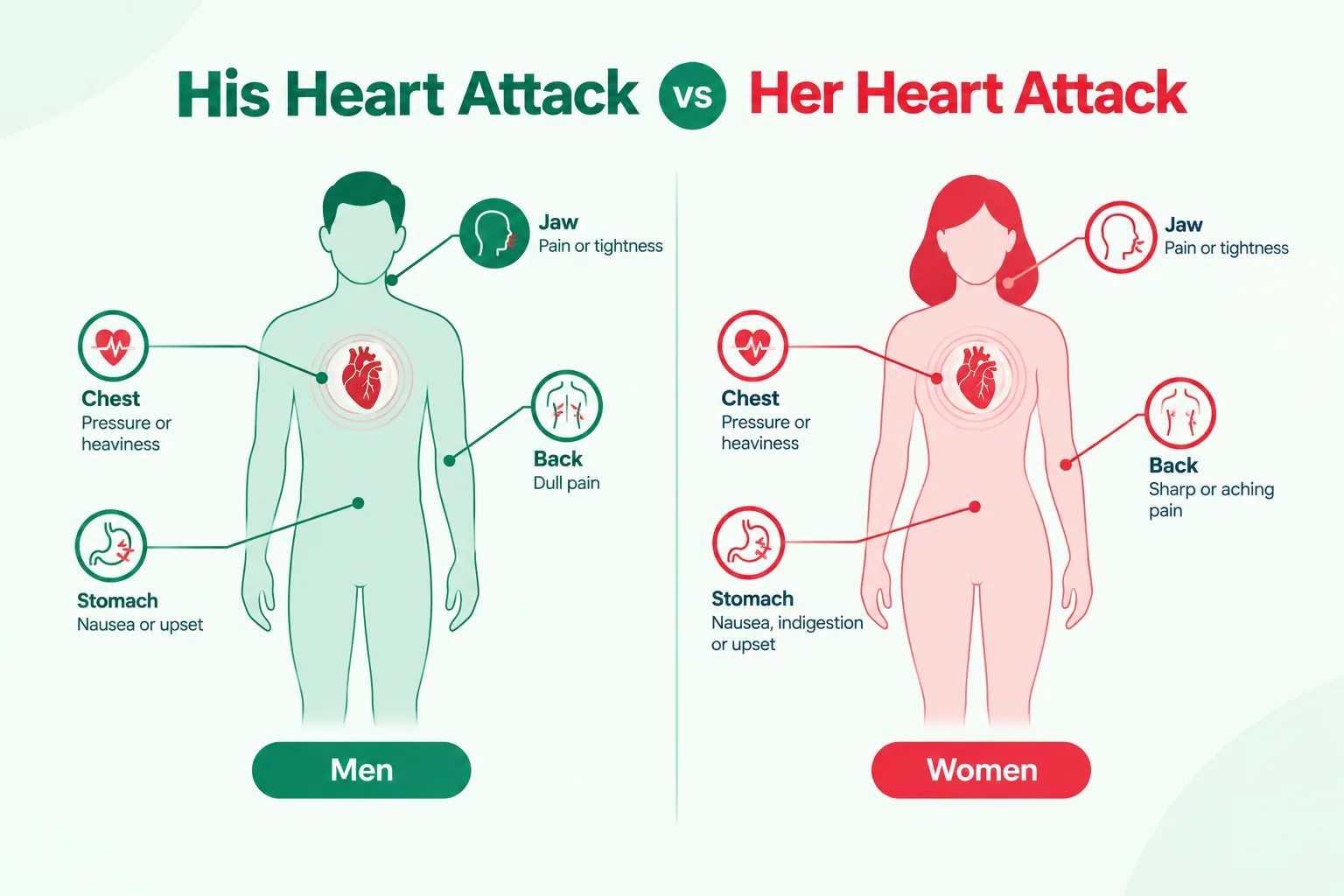
Women are more likely to have “atypical” symptoms, fatigue, breathlessness, and nausea, rather than the intense chest pain most commonly seen in men, which makes their heart attacks harder to recognise and easier to dismiss.
| Feature | Typical in Men | Typical in Women |
| Chest pain | Severe, crushing, central | Milder pressure, or absent |
| Onset | Sudden | Often gradual, over hours/days |
| Associated symptoms | Sweating, arm pain | Fatigue, nausea, breathlessness, back/jaw pain |
| Recognition | Usually identified quickly | Often mistaken for stress, acidity, or menopause |
| Care-seeking | Prompt | Frequently delayed |
Dr Mittal notes, “Women are also quicker to get a family member checked than themselves. Heart health tends to go to the bottom of the list, and that delay is exactly what we’re trying to change.”
Why Do Women Often Miss or Ignore These Symptoms?
Women often miss heart attack symptoms because they resemble everyday complaints, tiredness, acidity, or anxiety, and because heart disease is still widely perceived as a “man’s condition.”
Several factors contribute to this:
- Symptom overlap: Fatigue and nausea are easy to attribute to stress, poor sleep, or a busy schedule.
- Lower awareness: Public health messaging has historically focused on the “classic” male presentation.
- Caregiving priorities: Many women delay seeking care while attending to family responsibilities first.
- Hormonal assumptions: Oestrogen was long believed to be protective, leading some women, and even some clinicians, to underestimate risk before menopause.
Why Are Indian Women at Higher Risk?
Indian women face a higher and earlier burden of heart disease than women in many other countries, driven by central obesity, diabetes, and delayed diagnosis.
The data is striking: a Lancet Commission report identified cardiovascular disease as the leading cause of death in women, noting the condition remains understudied, under-recognised, underdiagnosed, and undertreated, and that it accounts for around 35% of female deaths worldwide.
In India specifically, a 2024 study in BMC Women’s Health covering more than seven lakh women found central obesity to be the most common risk factor, affecting 78.2% of participants, and nearly one in four women were found to be overweight or obese.
Research also shows almost 90% of Indian women with coronary artery disease have a family history of heart problems, alongside women-specific risk factors such as pregnancy complications and migraines.
How Is a Heart Attack Diagnosed and Treated in Women?
A heart attack in women is diagnosed using ECG, blood tests (cardiac enzymes), and echocardiography, and treated with urgent restoration of blood flow, most commonly coronary angioplasty or, in more complex blockages, bypass surgery.
Once a woman reaches the hospital, the priority is rapid diagnosis followed by the appropriate intervention. Many women present with blockages that are less visible on standard angiography, a pattern sometimes linked to disease in smaller vessels, which is why an experienced cardiac team matters.
For patients with associated vascular disease, related conditions such as peripheral artery disease or carotid narrowing (see our guide to carotid artery stenting) are also assessed, since atherosclerosis rarely affects just one blood vessel. Where multiple coronary arteries are involved, the choice between stenting and bypass follows the same principles outlined in our detailed comparison of CABG vs angioplasty.
Conclusion: What Should You Do If You Notice These Symptoms?
If you or someone you know experiences sudden fatigue, breathlessness, chest pressure, or jaw/back discomfort that doesn’t have an obvious explanation, treat it as a medical emergency and get to a hospital immediately, do not wait to see if it passes.
Time lost is heart muscle lost. Do not drive yourself; call for emergency transport where possible, and avoid “waiting it out” with home remedies for symptoms that could be cardiac in origin.
Dr Dinesh Kumar Mittal brings over 25 years of cardiothoracic and vascular surgical experience at Fortis Hospital, Shalimar Bagh, with a treatment approach built on accurate diagnosis and personalised care, particularly important for women, whose symptoms and disease patterns often differ from the textbook presentation. If you are someone experiencing the above mentioned symptoms consult a specialist today.

 WhatsApp