
Heart transplant cost in Delhi starts from approximately ₹18,00,000 depending on the complexity of the case, the type of donor heart matching required, and the duration of hospital and ICU stay. Since a heart transplant is one of the most complex procedures in cardiac care, an exact figure cannot be given without a full clinical evaluation, and any number quoted before that stage should be treated only as an indicative starting point.
Dr. Dinesh Kumar Mittal, Senior Cardiac and CTVS Surgeon at Fortis Hospital, Shalimar Bagh, Delhi, brings over 25 years of experience in advanced cardiac surgery and works closely with the hospital’s heart failure and transplant team to guide patients through evaluation, listing, and post-transplant care.
What Is the Average Heart Transplant Cost in Delhi?
Heart transplant cost in Delhi generally starts from ₹18,00,000 for an uncomplicated adult transplant at a NABH-accredited private hospital, with the upper range extending more for complex cases.
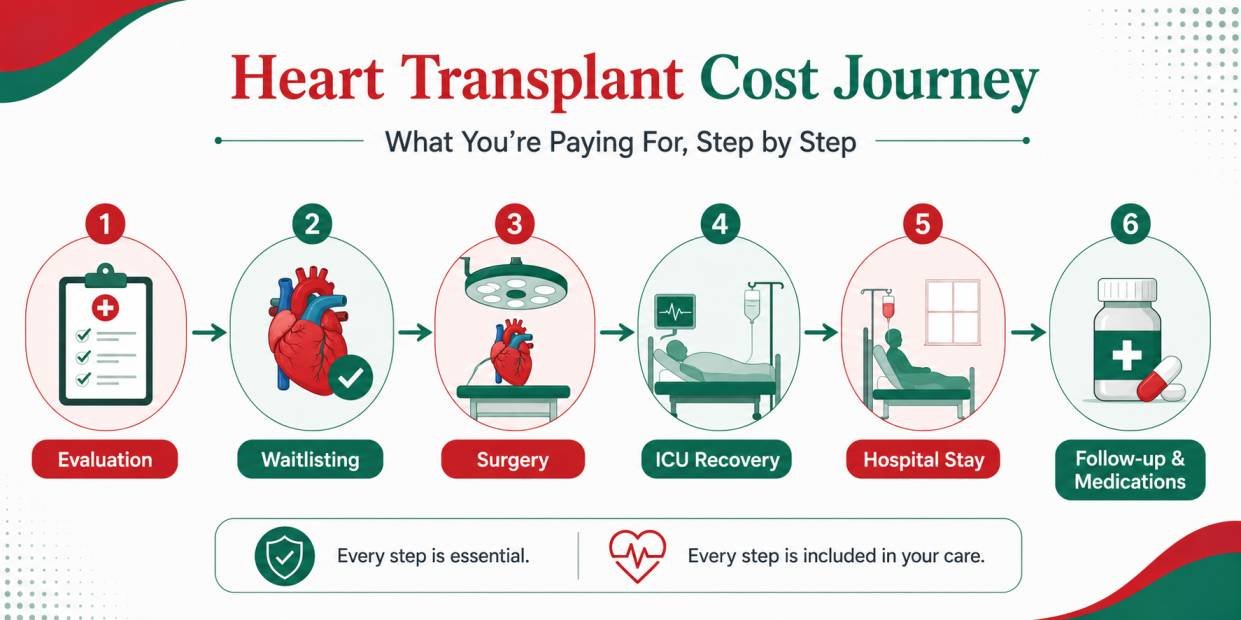
This is a wide range because a heart transplant is not a single fixed-price procedure. It unfolds in stages: evaluation, waitlisting, the transplant surgery itself, ICU recovery, and months of follow-up, each carrying its own cost. A patient with a straightforward case and no prior cardiac surgery will generally cost less than a patient who has had previous open-heart surgery, requires mechanical support such as ECMO or a ventricular assist device (VAD) before a donor heart becomes available, or develops post-operative complications.
Indicative cost range by stage:
| Stage of Treatment | Approximate Cost Range (INR) |
| Pre-transplant evaluation and workup | ₹1,50,000 – ₹3,50,000 |
| Waitlist period care (if mechanical support is needed) | Variable; can add several lakhs |
| Heart transplant surgery (hospital package) | ₹15,00,000 – ₹28,00,000 |
| ICU and post-operative hospital stay | Included in package; extended stays cost extra |
| First-year immunosuppressant medication and follow-up | ₹3,00,000 – ₹6,00,000 |
These figures are indicative only. The only way to receive a number specific to your situation is a clinical evaluation, since organ availability, donor matching, and individual health status all shift the final bill.
What Does the Heart Transplant Cost in Delhi Actually Include?
The heart transplant cost in Delhi covers several distinct components, not just the operation itself.
- Pre-transplant evaluation: A detailed cardiac, renal, hepatic, and immunological work-up to confirm transplant eligibility, including echocardiography, right heart catheterisation, blood group and tissue typing, and infection screening.
- Waitlisting and donor matching: Coordination through the National Organ and Tissue Transplant Organisation (NOTTO) network, including the cost of any bridging mechanical support required while waiting.
- Surgical and anaesthesia fees: The transplant surgeon’s fee, cardiac anaesthesia team, and operating theatre charges for an operation that typically takes four to six hours.
- Heart-lung bypass and organ retrieval logistics: Includes donor heart retrieval, preservation, and transport, sometimes via a “green corridor” arrangement when time-critical.
- ICU and ward stay: Transplant recipients typically need 7 to 14 days of combined ICU and ward care, monitored closely for signs of organ rejection.
- Immunosuppressant medication: Lifelong anti-rejection drugs are required, with the highest doses, and highest cost, in the first three to six months.
- Follow-up monitoring: Regular biopsies, blood tests, and echocardiograms for at least the first year to detect early rejection.
Why Can’t an Exact Heart Transplant Cost Be Quoted in Advance?
An exact heart transplant cost cannot be quoted in advance because the final price depends on variables that are only known once a donor heart is matched and the surgery is underway.
Unlike a planned procedure such as a bypass or valve repair, a heart transplant cannot be scheduled in advance. The patient is placed on a waiting list, and the operation proceeds only when a matching donor heart becomes available, sometimes urgently, sometimes after a wait of weeks or months. This uncertainty affects cost in several ways:
- Length of time on mechanical support: Patients who deteriorate while waiting may need ECMO or a VAD, each adding significant daily cost.
- Complexity of the surgery: Re-operative cases (previous heart surgery) or cases with adhesions take longer in theatre.
- Post-operative course: Some patients recover within the standard 10 to 14 days; others develop early rejection, infection, or kidney impact, extending the ICU stay.
- Hospital room category: General ward, twin-sharing, or private room accommodation directly affects the daily bill.
Hence, any quoted figure before a full clinical work-up should be understood as a planning estimate, not a fixed quote. A precise, written estimate is only possible after evaluation, and even then, it is presented as a likely range rather than a guaranteed final figure.
How Does Heart Transplant Cost in India Compare to Other Countries?
Heart transplant cost in India is substantially lower than in the United States, the United Kingdom, or the UAE, while following comparable surgical protocols and accreditation standards.
| Country | Approximate Heart Transplant Cost |
| India (Delhi NCR) | Starting from ₹18,00,000 (approx. USD 21,000) |
| United States | Starting from USD 1,000,000 |
| United Kingdom | Largely state-funded (NHS); private estimates run into hundreds of thousands of GBP |
| UAE | Significantly higher than India; limited domestic transplant capacity |
This cost difference is one reason international patients with Indian-origin family ties or medical visas often explore treatment in Delhi NCR, though a heart transplant for a non-resident involves additional regulatory and donor-matching considerations that should be discussed directly with the transplant team.
What Factors Increase or Reduce the Final Heart Transplant Cost?
The final heart transplant cost is shaped by the patient’s pre-transplant condition, the need for bridging mechanical support, the length of hospital stay, and the chosen room category.
Factors that tend to increase cost:
- Need for ECMO or VAD support while waiting for a donor
- Previous open-heart surgery (re-operative complexity)
- Co-existing kidney or liver impairment requiring additional management
- Post-operative complications such as early rejection or infection
- Private or deluxe room category during the hospital stay
Factors that tend to keep cost on the lower end of the range:
- Earlier referral and listing, before the heart failure becomes critical
- No requirement for mechanical bridging support
- Straightforward surgical anatomy with no prior cardiac surgery
- General ward or twin-sharing accommodation
- Smooth post-operative recovery without early rejection episodes
Why Choose Dr. Dinesh Kumar Mittal for Heart Transplant in Delhi?
Patients and families considering heart transplant in Delhi trust Dr. Dinesh Kumar Mittal for his depth of cardiac surgical experience and his transparent, step-by-step approach to a complex treatment pathway.
- 25+ years of cardiothoracic and vascular surgical experience
- MCh in Cardiothoracic Surgery from AIIMS, New Delhi
- Extensive experience managing advanced heart failure, including patients on mechanical circulatory support such as LVAD implantation as a bridge to transplant or as destination therapy
- Close working relationship with the heart failure and transplant team at Fortis Hospital, Shalimar Bagh, a NABH-accredited facility with cardiac ICU and ECMO support
- Honest, evidence-based guidance on whether transplant, mechanical support, or continued medical management is the right next step
- Transparent discussion of realistic costs and timelines, with no pressure toward unnecessary intervention
Heart transplant is not the first option explored for heart failure. In many patients, conditions such as cardiomyopathy or ischaemic cardiomyopathy can be managed for years with medication, lifestyle changes, and, when needed, surgical options such as CABG surgery before transplant becomes the only remaining route.
Book a Consultation for Heart Transplant Evaluation in Delhi
If a cardiologist has raised the possibility of heart transplant, the next step is a detailed evaluation to confirm whether transplant is appropriate and what the realistic cost and timeline will look like for your specific case.
During your consultation, Dr. Dinesh Kumar Mittal will provide:
- A thorough review of your heart failure history, current medications, and prior interventions
- Assessment of whether mechanical circulatory support is needed before a donor heart becomes available
- A clear explanation of the transplant evaluation and listing process through the NOTTO network
- An honest discussion of realistic cost ranges based on your specific clinical picture
- Guidance on insurance pre-authorisation and applicable government schemes
Frequently Asked Questions
Why is heart transplant cost given as a range and not a fixed price? expand_more
Heart transplant cost is given as a range because the procedure depends on donor availability, the patient's condition while waiting, the length of ICU stay, and whether complications arise, none of which can be predicted before evaluation and surgery.
Does heart transplant cost in Delhi include lifelong medication? expand_more
Hospital package costs typically cover the surgery and initial hospital stay only. Lifelong immunosuppressant medication is a separate, ongoing cost, highest in the first six months and reducing thereafter, and should be budgeted for separately.
Is heart transplant surgery covered by insurance in India? expand_more
Many comprehensive health insurance policies cover heart transplant as an inpatient procedure, subject to policy terms, sub-limits, and pre-authorisation. Government schemes may also provide partial coverage for eligible patients.
How long does recovery take after a heart transplant? expand_more
Most patients remain in the hospital for 2-4 weeks after a heart transplant, depending on their recovery and overall health. Regular follow-up visits, medications, and rehabilitation are essential.
How do I book a consultation with Dr. Dinesh Kumar Mittal? expand_more
You can book an appointment with Dr. Dinesh Kumar Mittal by contacting through the contact information already available directly or using their online appointment booking facility.

Dr. Dinesh Kumar Mittal's Content Team
Dr. Dinesh Kumar Mittal's medical content team specialises in creating accurate, clear, and patient-focused healthcare content. With strong clinical understanding and expertise in technical writing and SEO, the team translates complex medical information into reliable, accessible resources that support informed decisions and uphold Dr. Mittal's commitment to quality care.
This content is reviewed by Dr. Dinesh Kumar Mittal
Related Cost Information

Related Articles
Heart Surgery in India for International Patients: A Complete Guide
Every year, patients from the UK, the USA, the Gulf, and Africa fly into Delhi…
Read Article →
Varicose Veins Exercises: Best Movements to Improve Blood Flow
If you are also dismissing varicose veins as just a cosmetic issue, you might need…
Read Article → WhatsApp